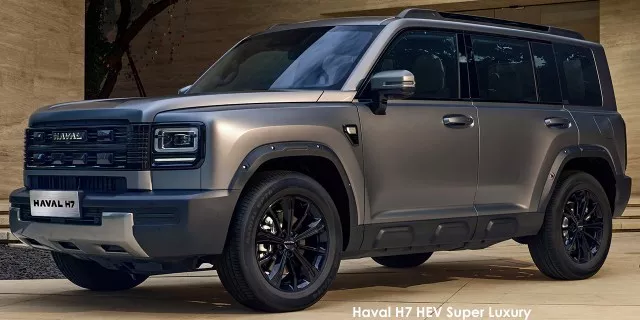
The South African government is currently mulling the idea of raising import tariffs on Chinese and Indian-made cars in an attempt to stem the flood of imports and protect the local car industry.
However, while the tariffs may have the well-intentioned goal of protecting our factories against foreign competitors, it fails to address the underlying issue in South Africa’s car market – a lack of affordable local alternatives.
South Africa is home to seven legacy carmakers – Toyota, VW, Ford, Isuzu, Nissan, BMW, and Mercedes-Benz – which have assembly plants around the country producing thousands of cars per day.
These companies have maintained a local presence for decades and are still incredibly popular, though their sales dominance is starting to be challenged by new rivals hailing from Asia.
The simple reason for this industry shift is that locally-made cars are increasingly unaffordable for the average salary, pushing many households towards more affordable alternatives.
South African-made cars are too expensive for South Africans
TopAuto looked at the starting price of every car made in South Africa and compared it with an equivalent import from China or India to highlight the price disparity between the two.
These were the results:
| Locally-made car | Starting price | Imported competitor | Starting price |
|---|---|---|---|
| VW Polo Vivo | R271,900 | Suzuki Swift | R227,900 |
| VW Polo | R373,800 | MG MG3 | R269,900 |
| Toyota Corolla Cross | R414,800 | Chery Tiggo 7 Pro | R389,900 |
| Nissan Navara Double Cab | R493,600 | JAC T8 | R399,900 |
| Toyota Hilux Double Cab | R534,100 | GWM P300 | R446,950 |
| Isuzu D-Max Double Cab | R567,200 | Changan Hunter | R449,900 |
| Ford Ranger Double Cab | R621,000 | LDV T60 | R480,000 |
| Toyota Fortuner | R685,900 | Mahindra Scorpio-N | R489,999 |
| Mercedes-Benz C-Class | R940,656 | BYD Seal | R1,004,900 |
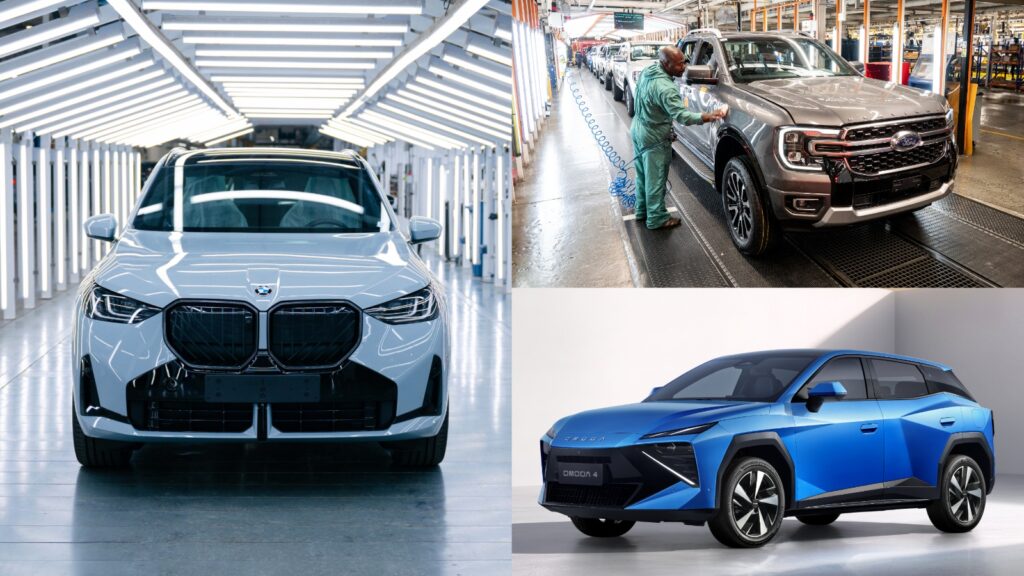
| BMW X3 | R1,069,760 | Omoda C9 | R785,900 |
In all but one case there is an imported rival that can be bought for a substantially lower price than the equivalent South African model.
The exception is the Mercedes-Benz C-Class, which is only because luxury sedans are an increasingly niche segment, and BYD is the only Chinese carmaker that sells one in South Africa.
Even the Polo Vivo, which is the only sub-R300,000 car on the list, is only the 25th most affordable car in South Africa, costing roughly R100,000 more than the country’s cheapest models.
The price difference between the local and imported cars is more severe when you consider that the average formal sector salary in South Africa at the end of 2025 was just R29,490 per month, according to Stats SA.
Financial experts recommend that you should never spend more than a fifth of your salary on vehicle instalments, which means most people can spend, at most, R5,898 on monthly repayments.
At the current prime lending rate of 10.25%, this gives motorists a budget of roughly R275,000 for a new car, assuming they take out a 5-year/60-month loan with no deposit.
In other words, the only local car most South Africans can afford is a base-spec Polo Vivo.
If we double this figure to account for households with two incomes, then its possible to afford something like a Corolla Cross or an entry-level Hilux.
Of course, they’d be doing so at a substantial long-term cost, as the interest paid on the Hilux over five years would come to R155,212, meaning they would have paid R689,312 by the time their contract ends.
Doing the same calculation with the entry-level GWM P300, you would pay R130,617 in interest for a final price of R577,567 – R111,745 less than the Toyota.
It’s an alarming demonstration of how much the interest paid on a car purchase can add up, and why it’s better to go with something comfortably within your price range rather than overextending your finances.
This is the reality most South Africans face, as the vast majority of cars sold here are bought with a finance plan.
It’s also clear that some of the cars made in South Africa are not primarily aimed at our market, as 97% of the BMW X3 units assembled in Gauteng are exported overseas.
Raising import tariffs on affordable Indian and Chinese cars, therefore, does nothing to address this issue, but there is a better solution.
Encourage local manufacturing

Toyota, VW, Ford, Isuzu, BMW, Mercedes-Benz, and Nissan are not the only carmakers with factories in South Africa.
Mahindra has established a facility at the Dube TradePort Special Economic Zone outside Durban in KwaZulu-Natal.
The site assembles the Pik Up bakkie from semi-knock-down kits imported from India, but does not have full manufacturing capabilities.
Similarly, the Chinese company BAIC has a factory in the Coega Special Economic Zone on the outskirts of Gqeberha in the Eastern Cape, which produces the Beijing X55 crossover and B40 Plus SUV.
It is also expanding the plant to accommodate the Foton Tunland G7 bakkie, and the B30 SUV.
Another Chinese automaker, Chery, is set to take over Nissan’s factory in Gauteng this year, as the latter brand has been struggling financially for years.
All three cases represent a massive local investment from some of South Africa’s fastest-growing brands, which is good news for job prospects and economic growth.
While the government’s proposed import tariffs may debatably encourage Chinese carmakers to establish a local manufacturing presence, it’s unrealistic to expect most of these brands to invest the billions needed to do so, especially in a country with poor infrastructure, load shedding, and a tumultuous political and economic landscape.
Furthermore, dealerships have warned that the tariffs are unlikely to help the industry long-term and will instead punish consumers who are already struggling with high car prices.
The Motor Industry Staff Association (Misa) warned the government to carefully consider the repercussions of such a move when attempting to protect OEMs and dealerships.
Misa operations CEO Martlé Keyter said that it was “late in the game” to consider imposing these tariffs, given how entrenched many Indian and Chinese car brands have already become with vast dealer networks.
“The influx of Chinese and Indian brands stimulated the local market and created massive competitiveness,” Keytler said.
“The result, new vehicle sales records for three consecutive months at the end of 2025, not only surpassing pre-pandemic levels for the first time but also reaching highs not seen in a decade.”




 Loading ...