


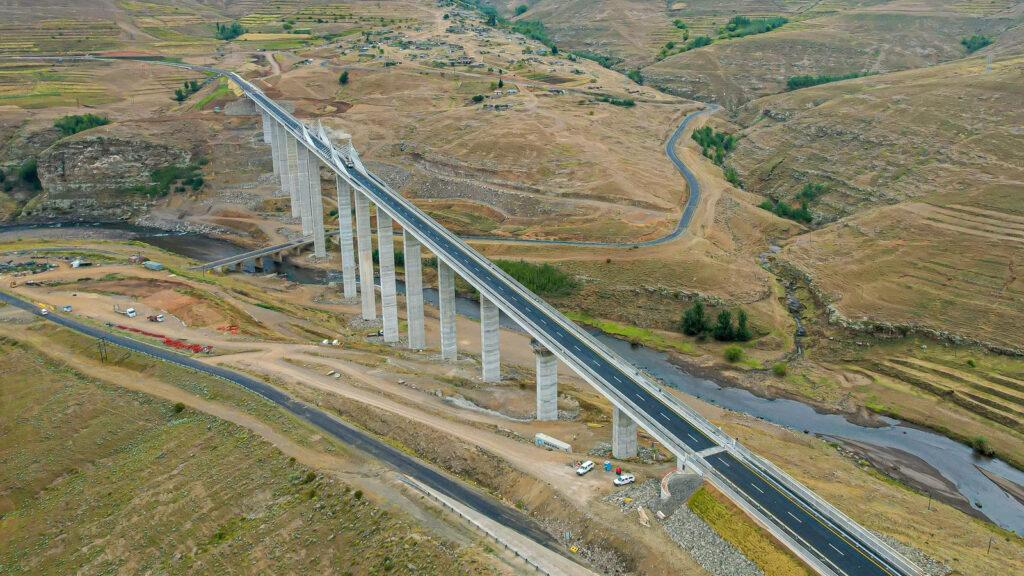
South Africa and Lesotho are set to open the completed Senqu Bridge tomorrow on Wednesday 22 April 2026.
The bridge’s completion represents a significant milestone for Phase II of the Lesotho Highlands Water Project (LHWP), which aims to improve regional integration and water security between the two countries.
The new Senqu Bridge, which cost approximately R4.2 billion to build, is the largest of three new elevated roads being developed for the project, the other two being the Khubelu and Mabuynyane bridges.
All three crossings are meant to ensure continued access across the Polihani Resevoir once water levels rise following the dam’s completion.
The dam itself is roughly 825 metres in length and 90 metres tall, and the Senqu Bridge will function as a vital path across the resevoir, maintaining national road access via the A1, which connects Mokhotlong to Maseru.
The LHWP is a multi-phased, treaty-based partnership between South Africa and Lesotho established on 24 October 1986 to address water security, energy generation and socio-economic development, according to SA News.
The projects makes use of the Orange-Senqu River system through a network of dams and transfer tunnels.
This network funnels water to South Africa’s Integrated Vaal River System, which supplies Gauteng.
Phase II of the LHWP includes the bridges, the dam, and a 38km transfer tunnel that will connect the Polihali and Katse resevoirs.
Once complete, the dam will increase water supply capacity from 780 million cubic metres per annum to 1,270 million cubic metres, helping to improve South Africa’s water security.
The now-completed Senqu Bridge represents an incredible engineering achievement built on difficult terrain.
It is the first extradosed bridge in Lesotho, combining cable-stayed and prestressed girder design, and was constructed using an incremental launching method to improve safety and reduce environmental disruption.
The project also helped to generate around 250,000 person-days of employment with a workforce of 1,200 individuals.
A project that began decades ago
Phase I of the LHWP was completed all the way back in 2003 when the foundations were laid for the current expansion.
This initial phase allowed for the construction of supporting infrastructure like the Katse and Mohale dams, and the Muela Hydropower station.
The Katse Dam, built in 1997, is one of the tallest dams in Africa and functions as the project’s main resevoir.
The completed Phase I systems provide 780 million cubic metres of water to South Africa each year, while Lesotho generates hydropower and earns revenue from water royalties.
Phase II began in 2022 and includes the aforementioned dam and bridges, as well as supporting infrastructure like feeder roads, accommodation facilities, power lines, and telecommunications.
Article photos source: Lesotho Highlands Development Authority
Senqu Bridge






 Loading ...