


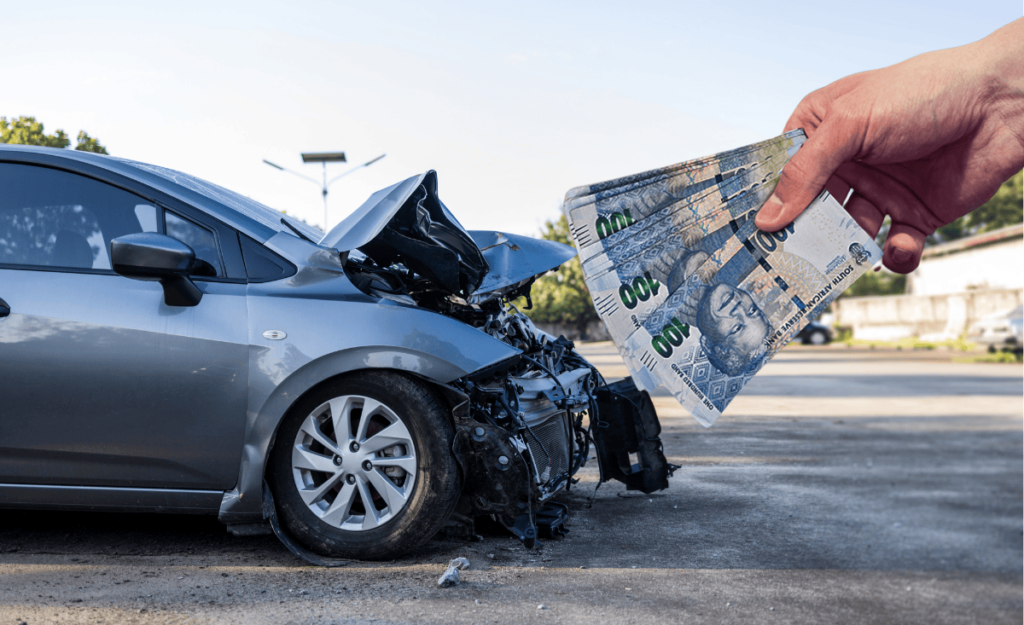
South Africa’s new driving laws are likely to lead to a significant increase in unlicensed drivers, putting insured motorists at greater risk.
This is according to South African insurance experts, who warned that the new Administrative Adjudication of Road Traffic Offences (AARTO) laws will amplify the problem of unlicensed drivers out on the roads.
The concerns centre around the new driver’s licence demerit point system, which will be implemented nationwide next year in one of the later phases of the AARTO rollout.
Car accidents in South Africa cost roughly R180 billion every year, with uninsured motorists putting insured ones at risk.
Nearly 70% of all cars on the roads are uninsured, meaning there is a two-in-three chance that one of the parties involved in an accident will not be able to pay for damages.
“We’re looking at over 2,000 accidents a day on roads where an estimated 65% to 70% of vehicles aren’t insured, according to data from the Automobile Association (AA) and the South African Insurance Association,” said Van Deventer Dowlath & Marx Inc Associate Director Tanya De Villiers.
AARTO is set to launch this week on 1 July 2026, starting with the country’s 62 largest municipalities. The remaining 151 municipalities will be added to the system between October and December 2026.
The new points system aims to emulate similar demerit programmes used in countries like the UK and Australia, where drivers will accumulate points on their licences for various traffic violations.
Once a driver receives 15 or more points, their licence will be suspended for a minimum of three months.
If a person has their licence suspended three times, it will be cancelled, and they will be required to apply for a new one once the suspension period is up, retaking their learner’s and driver’s tests.
In South Africa, car insurance policies require that motorists hold a valid driver’s licence. If the AARTO demerit system cancels a person’s licence, their insurance policy becomes void immediately.
Because of this, the number of uninsured, unlicensed drivers is expected to increase significantly.
“With the AARTO demerit system scheduled to begin penalising bad drivers with point deductions later this year, the chaos could escalate because drivers who lose their licences due to accumulated fines will automatically lose their insurance coverage,” said De Villiers.
AARTO and car insurance

De Villiers said most people assume that an insurance claim ends when their vehicle comes back from the panel beater. However, she said this is where the “real” legal procedure begins.
“Imagine you’ve stopped at a red light and a reckless driver smashes into the back of your car,” she explained.
“You report the accident, pay your excess, your insurer pays for the repairs, and then as far as you’re concerned, the matter is closed, but it isn’t.”
When the insurer pays your claim, they legally take the role of the insured party, inheriting the rights, and can sue the at-fault driver to recover their expenses.
If a negligent driver causes R50,000 worth of damage to a person’s car, the insured party pays R5,000 excess, and the insurance company pays the remaining R45,000.
De Villiers said that, through subrogation, the insurer assumes the legal burden of recovering the full amount from the guilty party.
“Once recovered, you get your R5,000 back, and the insurer keeps the R45,000. It’s a win-win for the consumer that costs the policyholder nothing,” she said.
She said this system is an essential legal tool that prevents drivers from avoiding financial responsibility simply because the person they collided with had insurance.
“Without subrogation, insurance companies would have to absorb billions of rands in losses every year. To survive, they would have to raise monthly premiums through the roof, forcing honest, insured motorists to pay for the country’s national road lawlessness,” she said.
The following table shows the fine amount and demerit points that will be issued for some of South Africa’s most common driving offences once the new laws are fully implemented:
| Violation | Fine amount | Demerit points |
|---|---|---|
| Exceeding speed limit by 11-15km/h | R250 | 0 |
| Exceeding speed limit by 16-20km/h | R500 | 1 |
| Exceeding speed limit by 21-25km/h | R750 | 2 |
| Exceeding speed limit by more than 40km/h | Criminal offence — Court hearing | 6 |
| Disobeying a stop sign or traffic light | R750 | 2 |
| Failing to use indicators | R500 | 1 |
| Driving without a licence | R1,250 | 4 |
| Driving unregistered vehicle | R1,000 | 3 |
| Driving vehicle without valid licence disc | R1,000 | 3 |
| Driving vehicle with one number plate | R500 | 2 |
| Driving vehicle without number plates | Criminal offence — Court hearing | 6 |
| Failing to keep left | R1,000 | 3 |
| Failing to stop at an accident | Criminal offence — Court hearing | 6 |
| Driving under the influence | Criminal offence — Court hearing | 6 |
| Furnishing false information | Criminal offence — Court hearing | 6 |






 Loading ...
-2026.10.webp)



-2026.10.webp)