


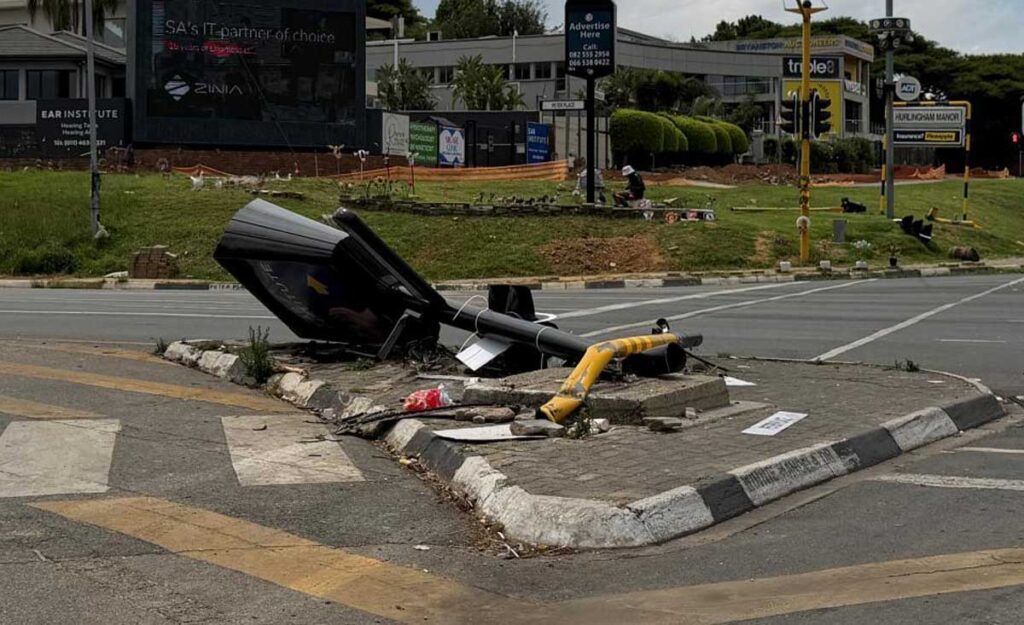
The City of Johannesburg’s road infrastructure is rapidly deteriorating, with vandalised bridges, thousands of potholes, non-functioning street lamps, and sabotaged traffic lights.
South Africa’s richest city is in a financial crisis, with mounting debts and a lack of liquidity to pay for essential services, including police and road repair crews.
On 15 June 2026, the City temporarily halted the diesel supply to the Johannesburg Roads Agency (JRA) vehicle fleet, citing payment issues.
“The City of Johannesburg is facing a fuel crisis that has left municipal services grounded and now threatens service delivery across the city,” the Democratic Alliance said at the time.
“Potholes cannot be repaired, traffic lights cannot be fixed, refuse cannot be collected, and water infrastructure faults cannot be attended to,” said the party.
While the issue was resolved a week later, the Centre for Risk Analysis (CRA) said that the City’s difficulties with funding its own vehicle fleet highlighted a more serious administrative failing than just poor service delivery.
“Road safety and economic costs rise the longer signals and potholes go unrepaired, with insurers and motorists bearing the immediate burden,” the CRA said.
“The inability to finance basic infrastructure maintenance damages the city’s negotiating position with creditors and intergovernmental partners.”
The JRA, which is responsible for maintaining the metro’s road infrastructure, has a maintenance backlog of over R115 billion, far exceeding the agency’s annual budget of R1.8 billion.
Traffic lights, in particular, have become a serious issue, as they are frequently targeted by criminals looking to steal the valuable wiring and components to sell for scrap.
This issue has become so prevalent that some parts of Gauteng have given up on repairing the robots at certain intersections, replacing them with stop signs.
The City of Johannesburg previously identified at least 400 non-functioning signalized intersections. One robot was vandalized 14 times before it was replaced with a stop sign.
Cape Town’s solution to traffic light theft

The City of Cape Town has been piloting new countermeasures at intersections to protect traffic lights and other valuable infrastructure from opportunistic scrap thieves.
One solution that has proven effective is the use of “submersible chambers,” which make it much harder to access the core components of a traffic light.
Deployed at certain high-risk intersections, these chambers encase most of the robot’s wiring and components in a concrete shell, which is then buried below the ground.
The chambers themselves are designed to be tamperproof, featuring sensors that can detect vibrations in the ground.
The sensors act as a warning system to detect when a thief may be trying to dig up the concrete base. If tripped, the sensor sends an alert to law enforcement, who are dispatched to the scene.
The chambers themselves are also self-sufficient, equipped with a UPS (uninterruptible power supply) and lithium-ion batteries, meaning they can function even during load shedding.
This also eliminates the need for exposed cables, making it even harder for criminals to steal anything of value.
Cape Town’s Mayoral Committee previously stated that these submersible chambers have proven to be a massive success, and that some of the city’s more problematic intersections are now running smoothly following the introduction of the new anti-theft measures.






 Loading ...
-2026.10.webp)



-2026.10.webp)