


South Africa is set for a diesel price hike next week, and petrol is likely to experience the same unless the global oil price makes a dramatic recovery.
This is according to the latest data from the Central Energy Fund (CEF), which shows that both petrol and diesel are still on an upward trajectory due to the war in Iran.
The CEF initially estimated that petrol would experience an over-recovery of R2.50 per litre, translating to a substantial price cut in August.
Diesel, on the other hand, was originally projected to receive a cut of R3.51 per litre, but this was before the US-Iran peace talks fell through and the two sides began launching new attacks. The Iran-aligned Houthis also attacked Saudi Arabian oil tankers in the Red Sea.
This caused the price of oil to surge from $68 per barrel (a low point since the war began in late February) to a high of $92 per barrel by 23 July.
Because of this, the CEF’s report for the fourth week of July showed that South Africa’s fuel price adjustments had deteriorated to a 41c per litre reduction for petrol, while diesel was set for an increase of R1.10 per litre.
These figures have grown worse since then, as the CEF’s latest data now shows that petrol will drop by just 29c per litre, while diesel will likely experience an even larger hike of R1.30 per litre.
These are the CEF’s fuel price adjustment predictions as of late July:
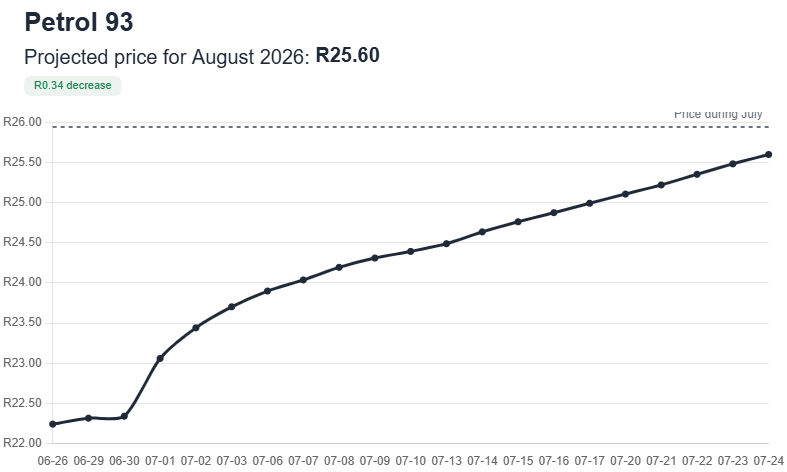
- Petrol 93 – decrease of R0.34 per litre
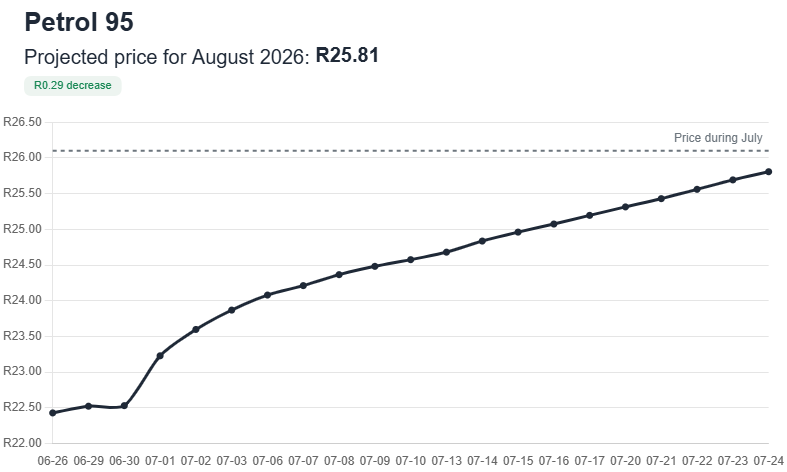
- Petrol 95 – decrease of R0.29 per litre
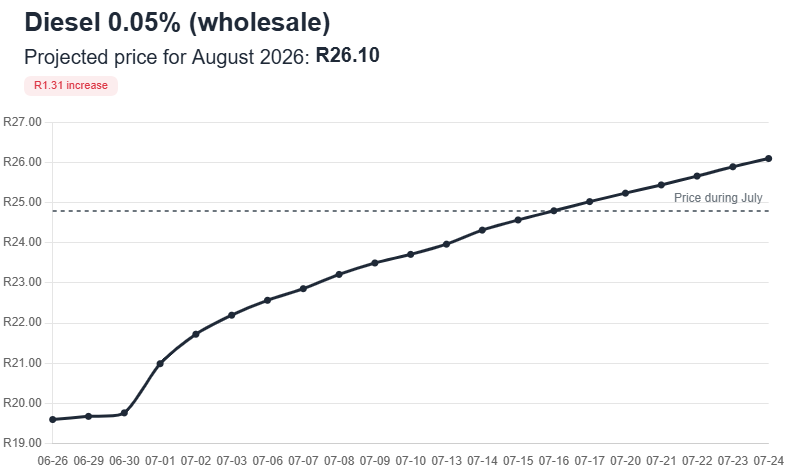
- Diesel 0.05% (wholesale) – increase of R1.30 per litre
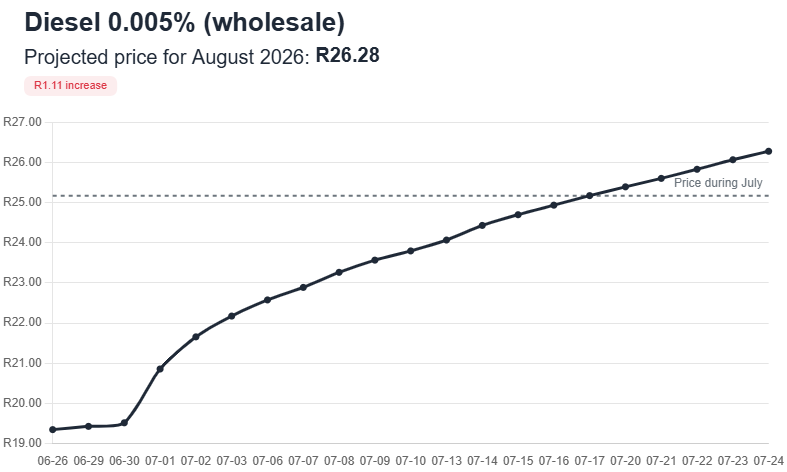
- Diesel 0.005% (wholesale) – increase of R1.10 per litre
This shows that, in the span of a month, South Africa’s diesel price swung by R4.81 per litre due to the war in the Middle East, while the petrol price cut dropped by R2.21 per litre.
Still hope for an improvement

The silver lining is that there is a chance the CEF’s fuel price recoveries may show an improvement by the time the Department of Mineral and Petroleum Resources (DMPR) makes the official fuel price adjustments next week.
Oil prices have fallen to $80 per barrel as of the time of writing due to a de-escalation in the conflict between the US and Iran.
Attacks between the two sides have stopped. Iran said it had stopped retaliatory attacks after two nights without American missiles, according to The Guardian.
US President Donald Trump said the country was having “good talks” with Iran, causing the price of Brent Crude to drop by 8% as traders hedged their bets on the possibility of uninterrupted oil supplies passing through the Strait of Hormuz.
The CEF’s data has yet to reflect these latest developments, which means that South Africa’s August fuel price recoveries may be better than shown.
That said, oil prices are still much higher than before the fighting resumed, so it’s unlikely we’ll see a major fuel price cut.
The question now is whether the situation in the Middle East will remain stable before the DMPR makes the official adjustments on Wednesday, 5 August 2026.
The following table shows how fuel prices will be affected in August, based on the current projections:
| Fuel Type | July fuel price | Projected change | Expected fuel price for August |
|---|---|---|---|
| Petrol 93 | R25.94 | – R0.34 | R25.60 |
| Petrol 95 | R26.10 | – R0.29 | R25.81 |
| Diesel 0.05% (wholesale) | R24.78 | + R1.30 | R26.08 |
| Diesel 0.005% (wholesale) | R25.17 | + R1.10 | R26.27 |
Petrol 93
Petrol 95
Diesel 0.05%
Diesel 0.005%





 Loading ...
-2026.10.webp)



-2026.10.webp)