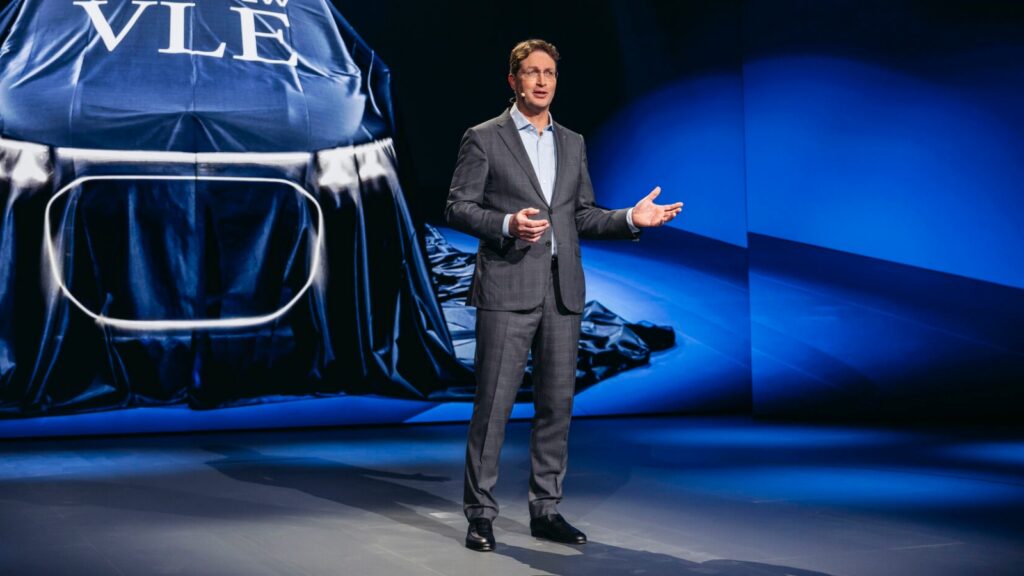
Mercedes-Benz CEO Ola Källenius expects the fierce pricing competition in the Chinese car market to stick around for years to come.
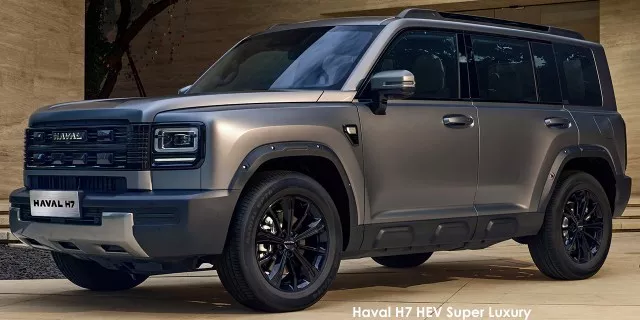
Chinese brands are spending an “enormous amount of money” to break into the country’s luxury-auto segment to compete with Mercedes models such as the S-Class and the G-Wagon, the CEO said at an event near Helsinki, Finland.
“That competitive intensity in China — I don’t believe it’s going to go away anytime soon,” Källenius told reporters. “It’s a new reality.”
Chinese manufacturers led by BYD are dominating electric vehicles in the world’s biggest auto market, feeding a near-ruinous pricing competition with quick successive launches of new models.
That’s led to sales declines for Mercedes, but also Porsche, BMW and VW’s Audi, which are restructuring to become leaner and more efficient.
Meanwhile, China’s luxury-car market has shrunk due to a protracted property crisis that’s weighed on big-ticket purchasing.
In the top-end segment that also includes Mercedes’ AMG performance models, the German brand still “dominates,” Källenius said.
The CEO made the trip to Finland to show off the new GLA, a compact sport utility vehicle with an illuminated grille and a more spacious interior.
The model is meant to bolster sales near the bottom end of the company’s lineup.
Mercedes is offering the SUV in several drivetrains, including a fully electric one with as much as 657km of range. German orders open on Thursday, with prices starting around €48,600 (R922,215).
Mercedes is pouring engineering resources into that part of its lineup, equipping smaller vehicles with technology previously reserved for more expensive models.
Like the recently released CLA sedan, the GLA offers rapid 800-volt charging, new software and an artificial intelligence-powered voice assistant.
The effort marks a shift from Mercedes’ first generation of purpose-built electric cars, including the EQS and EQE.
Their bow-shaped roof lines helped reduce drag but gave the vehicles an appearance that proved polarising, and sales fell short of expectations.
The GLA’s launch is a test of whether Mercedes can rebuild sales without undermining profitability.
The manufacturer needs models such as the GLA to replenish its customer base as demand weakens in China and its focus on higher-priced vehicles leaves it more exposed to a global luxury downturn.
Mercedes is targeting a return to annual car sales of about 2 million in the medium term, compared with roughly 1.8 million last year.
When reporting earnings this week, Mercedes pledged more cost cuts, particularly in Germany, to underpin returns after a 30% second-quarter sales drop in China.
That decline wasn’t much bigger than the slump in the country’s overall market, Källenius said in Finland. Mercedes is managing pricing in China “as carefully and financially sound as we can.”
The redesigned GLA is aimed mainly at customers in Europe, where demand for EVs has been rising.
The SUV has a lower silhouette and longer wheelbase than its predecessor, creating more interior space while giving the model a sportier stance.
The car “looks like a predator,” Källenius said.




 Loading ...