The Automobile Association of South Africa (AA) is pushing for new safety regulations for entry-level cars sold across the country.
This is part of the AA’s broader SaferCarsForAfrica campaign, which was created to highlight the discrepancy in safety standards between cars sold in Africa compared to other markets.
It argues that all cars sold in South Africa should be required to carry a minimum level of safety equipment, and that features such as airbags should not be treated as optional extras reserved for more expensive trim levels.
TopAuto recently contacted the AA to learn more about the goals it is trying to achieve in our market, including its drive for more safety equipment to be required as standard on all vehicles, regardless of their market positioning.
The CEO of the AA, Bobby Ramagwede, explained that the AA has collected data highlighting two critical missing elements in the basic passive safety of vehicles sold in South Africa.
“These are Electronic Stability Control and a suite of 6 airbags. Combined with stronger materials that prevent avoidable body shell deformation under the simulated load, these life-saving features are a must for all new vehicles sold in South Africa,” he said.
“Cars with these features typically score at least a 3-star GNCAP safety rating; the minimum rating the AA deems to be satisfactory.”
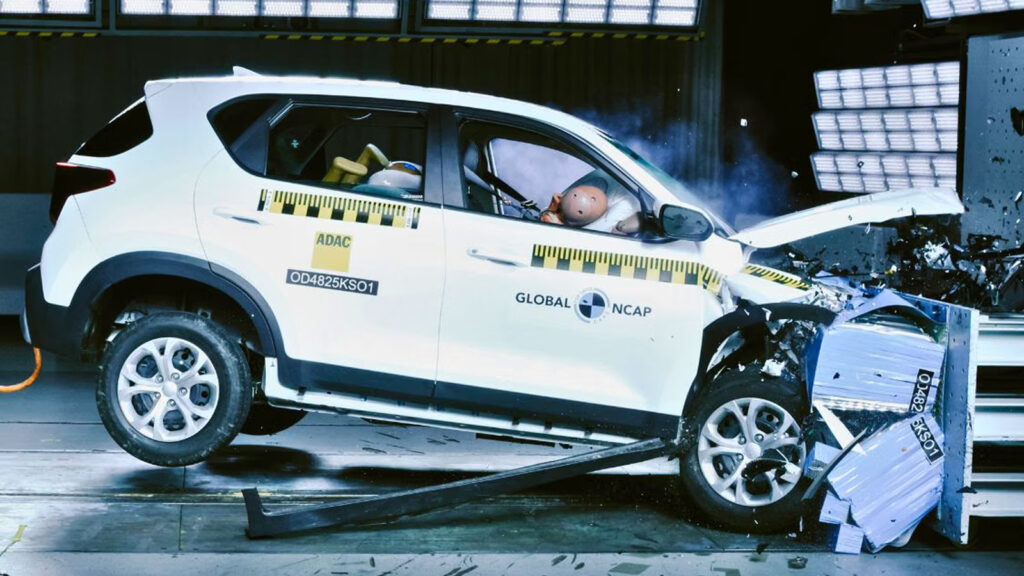
Ramagwede highlighted the crash tests conducted by the AA in collaboration with the Global New Car Assessment Program, where entry-level cars sold in South Africa were submitted to frontal and side-impact occupant safety tests.
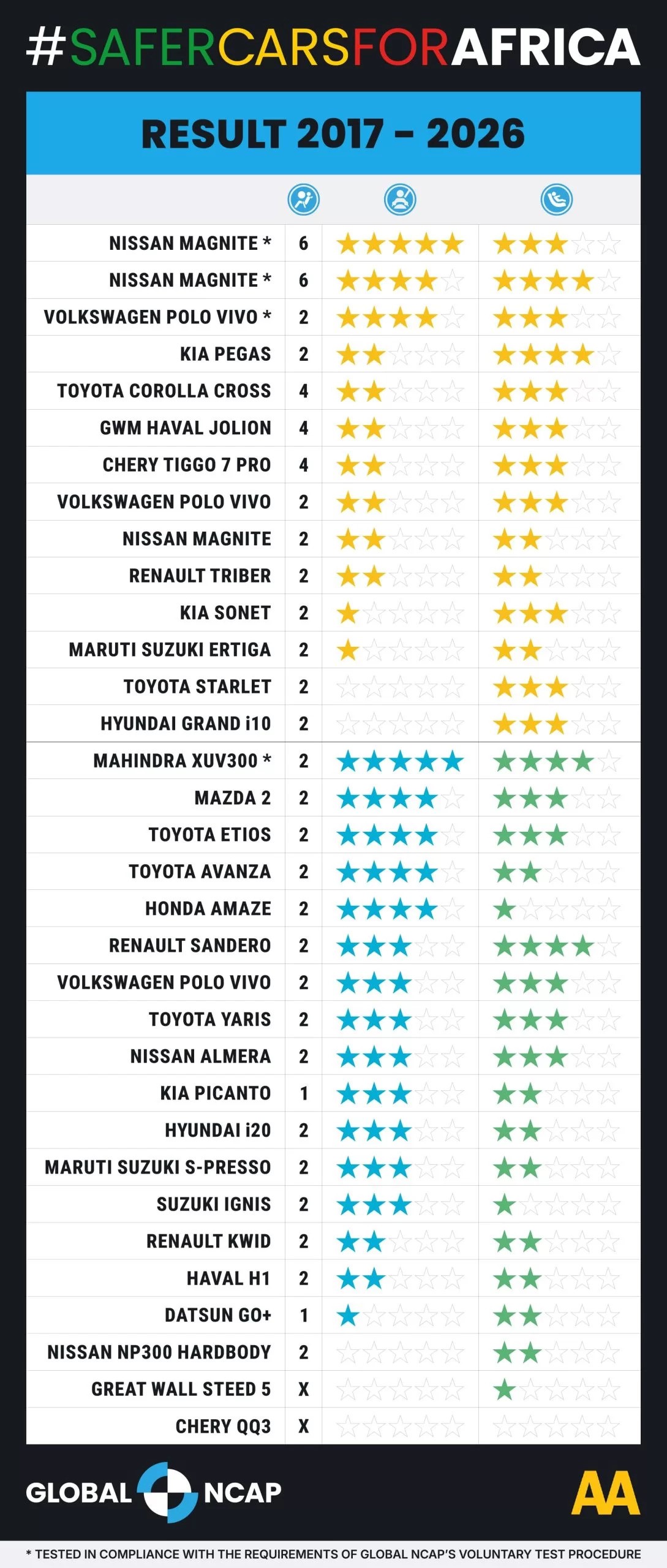
Some recent examples of these tests include the base versions of the Hyundai Grand i10, Kia Sonet, Haval Jolion, and Toyota Starlet, all of which achieved scores of less than 3 stars for adult occupant safety.
“Road safety is not merely a policy priority; it is a shared global responsibility. The AA has long championed best practices in mobility, and our commitment extends beyond advocacy. We focus on translating principles into meaningful action, and our partnerships reflect that approach,” it said.
“Through collaboration with organisations such as Global NCAP, we are actively advancing #SaferCarsForAfrica. These partnerships are substantive, delivering measurable impact by elevating vehicle safety standards, supporting robust crash-testing programmes, and encouraging manufacturers to prioritise the safety of drivers and passengers.”
These were the results for all cars crash-tested by the AA. The score in the second column is the adult occupant safety rating, while the one on the right is the child occupant safety rating.
Pushing for safety changes in South Africa
The carmakers that have achieved below-average crash test scores have often responded that their vehicles meet South African safety regulations; however, the AA argues that these standards are far too low.
Ramagwede noted that cars sold in Africa are held to a much lower safety standard than ones sold in other regions, such as Australia or the European Union.
He said the AA is in active talks with the National Regulator for Compulsory Specifications (NRCS) to drive minimum safety standard reforms.
“The NRCS has recently published a gazette in an effort to address the AA’s prescription. We will ensure that the revised standards feature our prescribed minimums to ensure effectiveness of the reforms.”
Alongside new reforms that would require entry-level cars to include additional safety equipment as standard, the AA wants to establish a dedicated African NCAP to crash test all cars sold on the continent.
Right now, there is no NCAP test for our market. Instead, motorists rely on carmakers sharing the results of crash tests conducted in other regions such as Europe, China, or India, which are not always representative of the models sold here.
“In addition to legislative changes, the AA’s ultimate goal is to establish an Africa NCAP to ensure compliance is honoured ahead of the vehicles being sold to the consumer,” said Ramagwede.
“The Africa NCAP will play a critical role in ensuring standards are upheld and that the safety features fitted to cars are effective in protecting occupants.”
“Having 6 airbags and ESC is not a guarantee that the vehicle is safe. Our independent tests are purposed to ensure that the safety features do what they promise to do.”





 Loading ...