


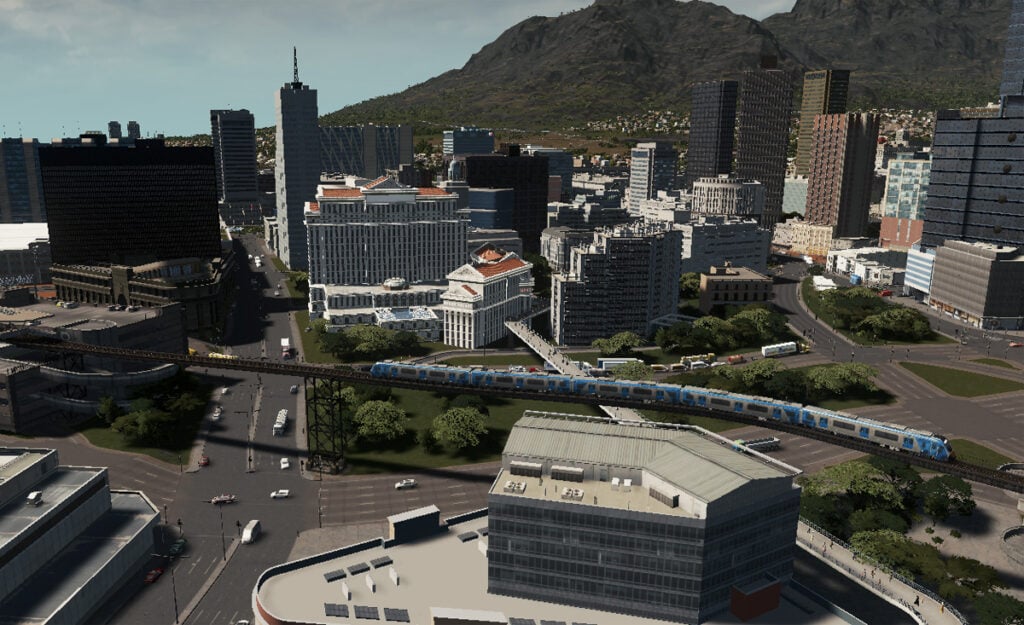
The ambitious plan to create a new elevated train service through the centre of Cape Town has been given a shot in the arm, thanks to the recent announcement that the Foreshore Freeway will finally be completed.
Last week Friday, Cape Town Mayor Geordin Hill-Lewis announced that the City will finish construction of its famous unfinished bridge as part of a massive plan to redevelop the central business district (CBD).
“This is an historic day for Cape Town. Every one of us who has grown up in Cape Town has looked up at these big unfinished bridges time and time again and wondered what happened, why they were never finished, and when they ever would be,” he said.
The bridges will be completed to improve traffic flow and reclaim 15 hectares of underutilised land, which will be transformed into a new neighbourhood with a seaside promenade.
“I am excited to unveil this vision for a new Foreshore precinct that will see these legendary bridges being finished at last,” said Geordin Hill-Lewis.
“We’ve been working on this project for the last few years in detail, but in truth, we’re getting the ball rolling on finishing some 50-year-old unfinished business!”
This announcement has been well received by the minds behind the Capetrain Express, a viral proposal to create a brand-new commuter railway linking key destinations across Woodstock, the Cape Town CBD, Green Point, and Sea Point.
“The Capetrain Express welcomes the announcement by the Executive Mayor of the City of Cape Town of the Foreshore Precinct Project as a generational investment in the redevelopment and revitalisation of the lower CBD,” it said in a statement.
“We are encouraged by the Executive Mayor’s public remarks expressing in-principle support for the Capetrain Express as a potential addition to Cape Town’s public transport network, subject to the project demonstrating its financial viability.”
“The Executive Mayor’s public statement that the Foreshore Precinct Project has been planned in such a way that there is sufficient space for a future railway line is a positive indication that provision has been made for future rail infrastructure within the precinct.”
The project’s leaders said they support the redevelopment of the Foreshore Precinct and that they are ready to work with the City and relevant stakeholders.
“We look forward to meaningful engagement during the public consultation process and to exploring how a financially viable, high-capacity rail corridor could complement the precinct’s plans and expand access to jobs and opportunity as the city-region prepares for a population approaching 10 million residents by the middle of the century.”
It noted that the City of Cape Town’s 2050 Long-Term Plan (2025) sets a benchmark for 75% of all commuter trips to be made using public transport by 2050.
“The high-capacity rail corridor proposed by the Capetrain Express for the Foreshore Precinct is aligned with the City’s stated policy objectives and represents a realistic and serious proposal to advance the greater realisation of the City’s stated vision,” it said.
“We share the City’s ambition to create a world-class Foreshore Precinct that benefits all Capetonians, strengthens Cape Town’s global competitiveness and builds lasting prosperity for generations to come.”
The proposed route for Cape Town’s sky train
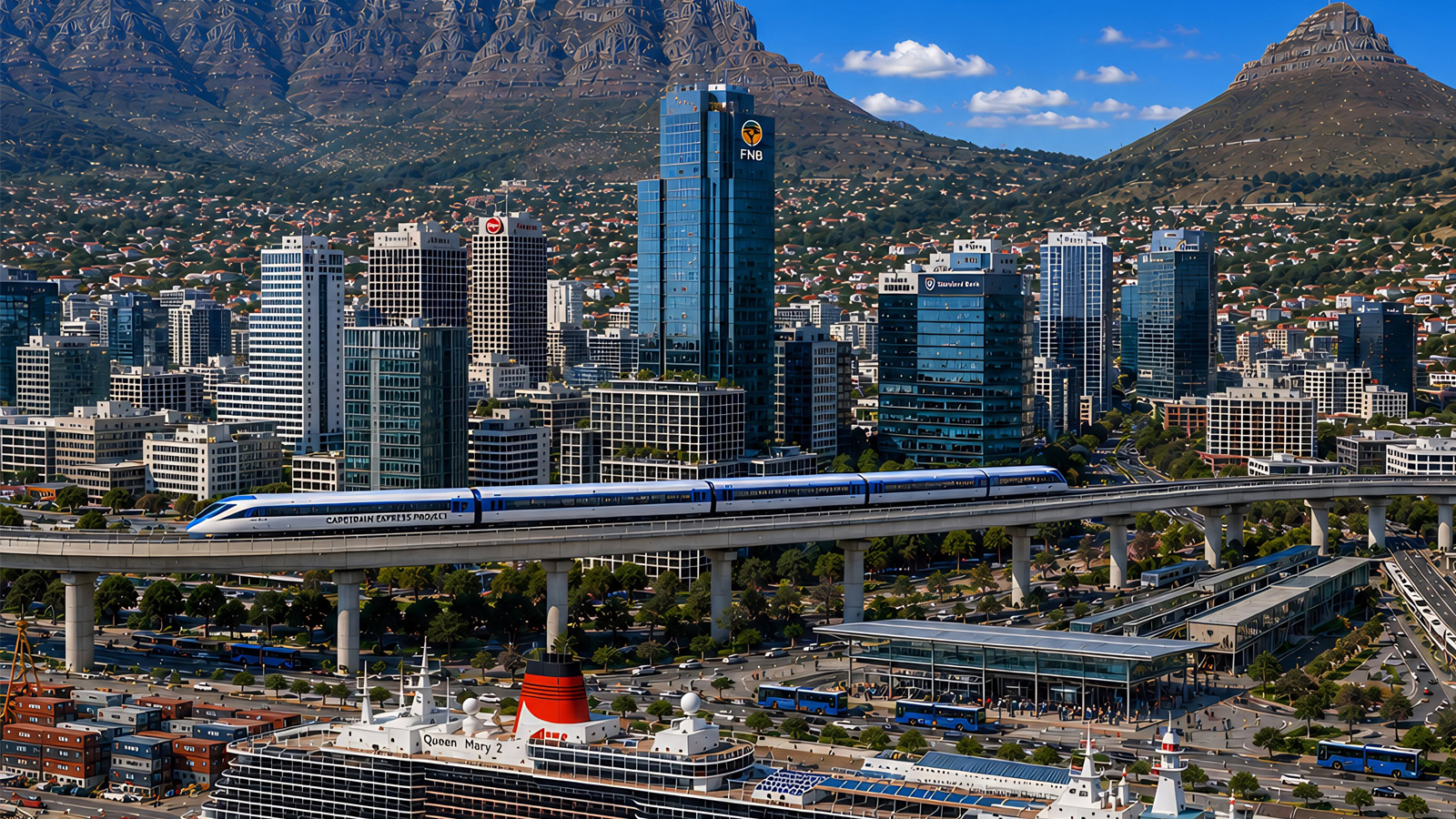
The project, envisioned by South African development engineer Gareth Ramsay, proposes to build an elevated railway running from Woodstock to Sea Point, with two additional stations near the Cape Town International Convention Centre (CTICC) and Cape Town Stadium in Green Point.
The service would make use of the existing road infrastructure, including the Foreshore Freeway, and would feature two lines in some sections, allowing trains to pass in both directions.
Other sections would only have a single line, and trains would move back and forth at timed intervals.
“This Cape Town Sky Train would enable the current plans for the expansion of the Waterfront at Granger Bay and densification of the Atlantic Seaboard area, without increasing congestion,” said Ramsay.
He added that the CTICC and stadium stations would greatly improve access to these sites while reducing congestion in the area.
“The Cape Town Stadium Station would significantly enhance stadium event access and the spectator experience, with no further need to battle the traffic before and after major events and the inconvenience this causes residents of the area.”
“The CTICC station would support the City’s goal of making Cape Town the destination of choice for major conventions, exhibitions and conferences and with a link to the Cape Town Cruise Terminal it could also reduce congestion during the embarking and disembarking of cruise ships during the cruise season.”
Furthermore, the train would be integrated with the MyCiTi bus service, which would continue to serve a crucial role as a last-mile transport solution.
The Capetrain Express, as it has come to be known, has gone viral on social media with many residents expressing interest in the proposal.
A Facebook page has also been created with AI-generated images depicting how the railway may look, including the stations.
However, when TopAuto previously contacted the City of Cape Town in 2024 to ask if it supported the idea, it said the train was not under consideration.
Rob Quintas, the City’s Mayoral Committee Member for Urban Mobility, explained that such a project would require significant investment in infrastructure and operations.
“Given the City’s budget limitations and the need to prioritise cost-effective solutions, funding such a project is not viable,” he said.
Quintas added that the City has already invested in other public transport services like the MyCiTi bus, which already operates in the CBD, Green Point, and Sea Point.
“Investment in improving existing services is more practical and cost-effective,” he said.




 Loading ...
Conversation
5 commentsAnd the rate payers will pay for this pie in the sky again. Same with the desalination plants that they started and then stopped.