Long-term car rentals are growing in popularity as an alternate route to vehicle ownership in South Africa.
Also known as vehicle subscriptions, the service is touted as a way to bypass bank finance, balloon payments, and increasingly-long repayment solutions.
The option has seen a surge in interest over the past few years because it offers a lower financial barrier compared to traditional car ownership, especially since many subscription models bundle costs like insurance and maintenance into a single monthly fee.
One company benefitting from this demand is Drive.co.za, a South African startup that describes itself as “the Netflix of cars.”
Founded in August 2020, the Pretoria-based firm capitalized on the need for flexible vehicle options at the height of the Covid-19 pandemic.
Since then, Drive.co.za has greatly expanded its business and has been recognised as the third-fastest-growing company in South Africa, according to News24.
Similarly, the Financial Times listed Drive.co.za as the ninth-fastest-growing company in Africa.
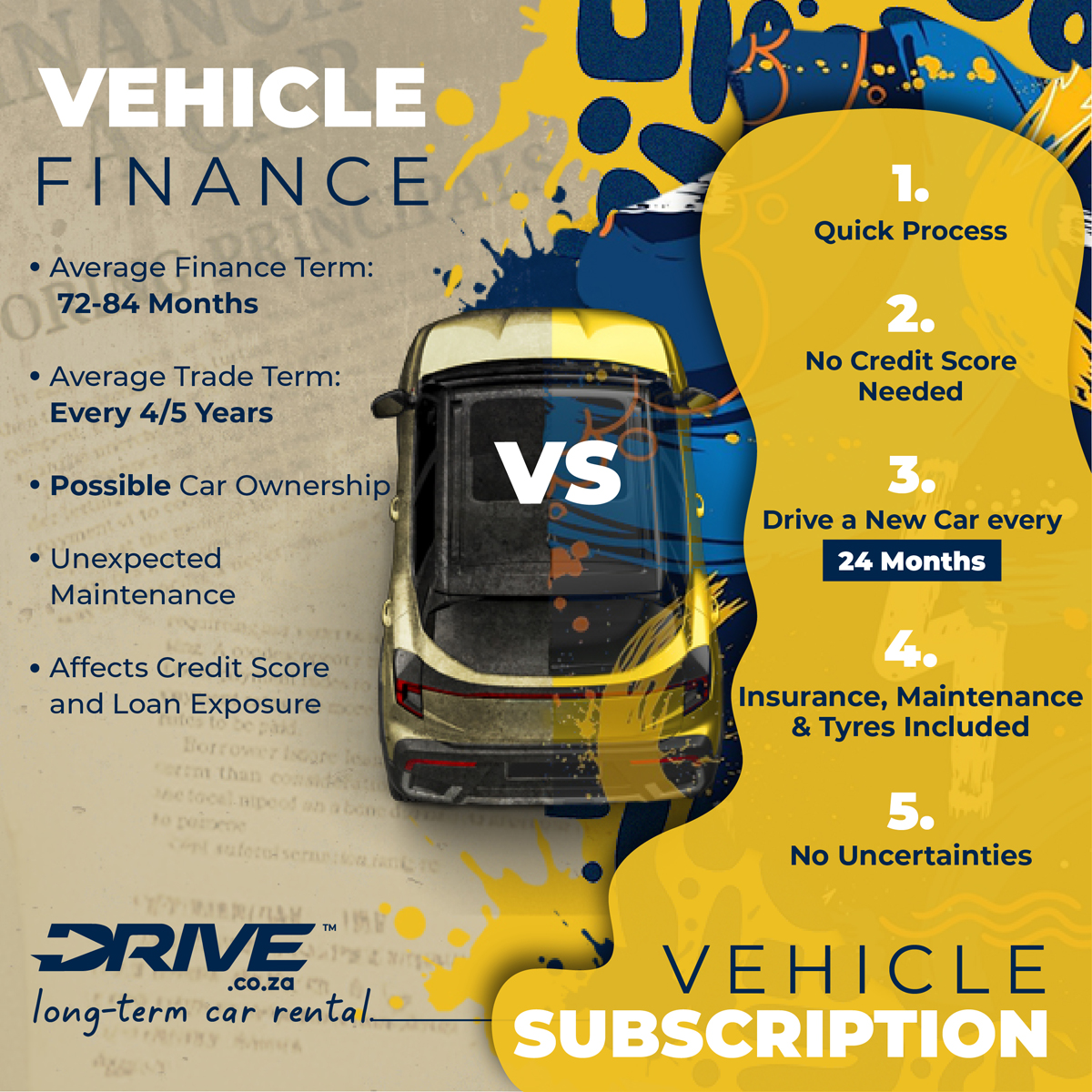
The company stated that its model allows customers to select a new vehicle, pay a fixed monthly fee, and enjoy full use without the debt burden, depreciation or credit score impact of traditional finance.
This fee covers insurance, maintenance, tyres, and roadside assistance, and customers have the option to upgrade or change their car every 12 or 24 months.
“Customers want freedom and predictability,” said Willie Jooste, Co-Founder and Director at Drive.co.za.
“They want to drive a new car without worrying about maintenance or insurance shocks. That’s what Drive delivers.”
The company’s other co-founder and director, Roelof Janse van Vuren, explained that they consider behavioral, geographic and affordability data to assess both the vehicle and the person driving it.
“We look at three layers of risk: the asset, the individual and their relationship with the asset.”
“Our model predicts not just ability to pay, but willingness to pay.”
Cost of car ownership through the roof
WesBank previously highlighted that the cost of vehicle ownership has skyrocketed in South Africa.
Entry-level models, in particular, have been negatively impacted by factors like car price inflation, the depreciation of the rand, and higher interest rates.
The VW Polo Vivo, for example, now costs a minimum of R271,900, which works to a monthly instalment of R5,905 on a standard 60-month plan.
However, 72-month, 84-month, and 96-month plans are now the norm in South Africa – a consequence of motorists agreeing to longer contract terms in a desperate move to keep up with rising car prices.
It’s therefore understandable why more people are turning to long-term vehicle rentals, even if this means they don’t actually own the car they’re paying for every month.
Other companies have also gotten involved in the car subscription landscape, including Avis and Toyota.
The rental company Avis launched a service called iLease in late 2023, which offers contracts ranging from 12 to 48 months with custom mileage parameters.
This includes comprehensive insurance, standard vehicle maintenance and tyre replacement, a telematics device, roadside assistance, and yearly licensing costs.
Toyota offers its own service called Kinto One, which is a “pay-for-use mobility solution that lets consumers take out a Toyota or Lexus model for up to five years.
The monthly includes all scheduled service, maintenance, and licence fees without taking ownership of the vehicle.





 Loading ...
-facelift-2-2025.10.webp)
-2025.11.webp)