The Indian and Chinese car brands with factories in South Africa – With another on the way


There are two car factories in South Africa owned by Chinese and Indian manufacturers, and a third site will soon be taken over by a Chinese company as well.
Over the past five years, the South African car market has experienced a major shift as new vehicle brands from Asia have entered the market in droves, driven by the demand for affordable transport options.
One of the biggest criticisms against the influx of these new brands is that they are competing with carmakers with a local manufacturing presence, thereby threatening jobs and billions of rands in investments and infrastructure.
Related to this is a concern that South Africa is not big enough to support all of these new brands, especially when you consider that only a fraction of the country’s working population earns enough to pay income tax.
This means that many of the Asian brands that have entered the market in recent years are unlikely to find success and will pull out in short order, effectively competing with local carmakers and established dealer networks while leaving nothing behind over the long term.
In light of this, many industry stakeholders have called on foreign car brands to invest more heavily in South Africa to solidify their presence, establishing new dealerships and assembly facilities to create new jobs and stimulate economic growth for the country as a whole.
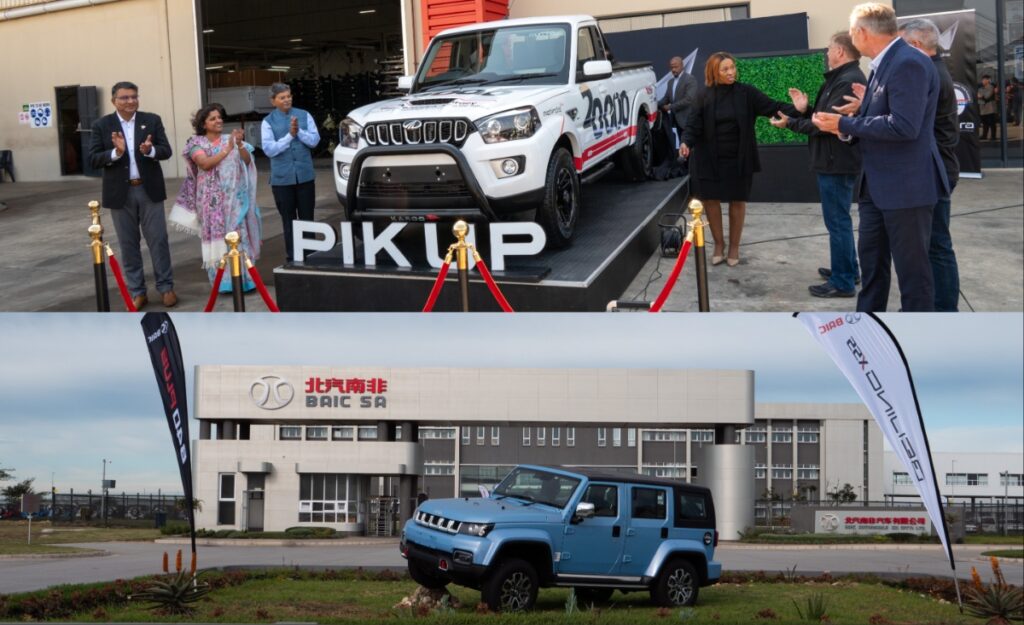
Two companies have already done this, as the Indian automaker Mahindra has a factory in KwaZulu-Natal while the Chinese firm BAIC and its sub-brand Foton have established themselves in the Eastern Cape.
What’s more, Nissan’s plant in Gauteng will soon be taken over by Chery, making it the second Chinese company to establish a local manufacturing presence in South Africa.
Mahindra in South Africa

Mahindra has a vehicle assembly plant at the Dube TradePort Special Economic Zone in KwaZulu-Natal, where it produces the Pik Up bakkie.
The site does not have full manufacturing capabilities; rather, it assemble the Pik Up from semi-knock-down kits imported from India.
Nevertheless, the operation represents a massive investment from Mahindra, as the original facility was established in 2018.
Mahindra has been one of the rising stars of South Africa’s car industry in recent years, and its growing popularity led the company to expand its local operations in 2025 with the opening of a second facility, located close to the original plant.
“Our original facility played a pivotal role in establishing our local footprint,” said Rajesh Gupta, CEO of Mahindra South Africa.
“As demand for our locally assembled Pik Up range continued to rise, we needed a facility with the scale, flexibility, and technology to meet future growth while maintaining world-class quality.”
The expanded operation now has the capacity to assemble more than 1,000 Pik Up single cabs and double cabs per month.
Mahindra also revealed that it partnered with the Industrial Development Corporation (IDC) in early 2025 to launch a feasibility study into building a full-scale manufacturing plant in South Africa.
BAIC and Foton in South Africa

As for BAIC, it has established a car factory in the Coega Special Economic Zone on the outskirts of Gqeberha in the Eastern Cape.
Back in 2016, the state-owned Chinese carmaker announced that it had partnered with the IDC to establish a facility on local soil.
The first cars were scheduled to roll off the line in 2018, but several ensuing disruptions meant that production at the site didn’t start until 2023.
This included a dispute with the original contractor, the Covid-19 pandemic, and supply chain issues caused by the Russia-Ukraine war.
BAIC, which is short for Beijing Automotive Industry Corporation, announced it had begun construction on the first Beijing X55 crossover and B40 Plus SUV units in mid-2023 for both local and export markets.
The 70,591-square-metre site led to the creation of BAIC South Africa, where the carmaker retains a 65% stake, while the IDC holds the remaining 35%.
This site is also currently undergoing a major expansion, as BAIC’s sub-brand Foton intends to assemble the Tunland G7 bakkie from complete knock-down (CKD) kits at Coega.
A pre-production example made its way off the assembly line in October 2025, making Foton the first Chinese carmaker to establish CKD operations for commercial vehicles in South Africa.
The BAIC B30 SUV, which debuted in November last year, is also set to be built from CKD kits at the company’s factory.
BAIC previously said that production may start as soon as January 2026, but it has yet to confirm whether it achieved this deadline.
Chery’s “new” factory

In January 2026, it was announced that Chery will take over operations at Nissan’s Navara bakkie factory in Rosslyn on the outskirts of Pretoria.
Nissan has been in dire financial straits for years, and is currently in the process of shutting down several facilities around the world, including two sites in its home country of Japan.
At the same time, Chery has been rapidly expanding its presence in South Africa, launching multiple sub-brands while achieving record sales.
The Chinese automaker previously expressed interest in establishing a local manufacturing presence, and so it came as little surprise when Nissan announced that Chery would acquire its facility.
“Nissan and Chery SA have reached agreement on the acquisition of Nissan’s manufacturing assets in Rosslyn, South Africa,” said Nissan.
“Subject to the fulfilment of certain conditions, including regulatory approvals, Chery SA will purchase the land, buildings and associated assets of the Nissan facilities, including of its nearby stamping plant, in mid-2026.”
The two companies said that the acquisition will ensure that the majority of Nissan SA employees will be offered new positions on “substantially similar terms and conditions as today.”
Nissan stressed that it is not leaving South Africa and plans to launch multiple cars this year, including the new Patrol and Tekton.


 Loading ...
-facelift-2-2025.10.webp)
-2025.11.webp)