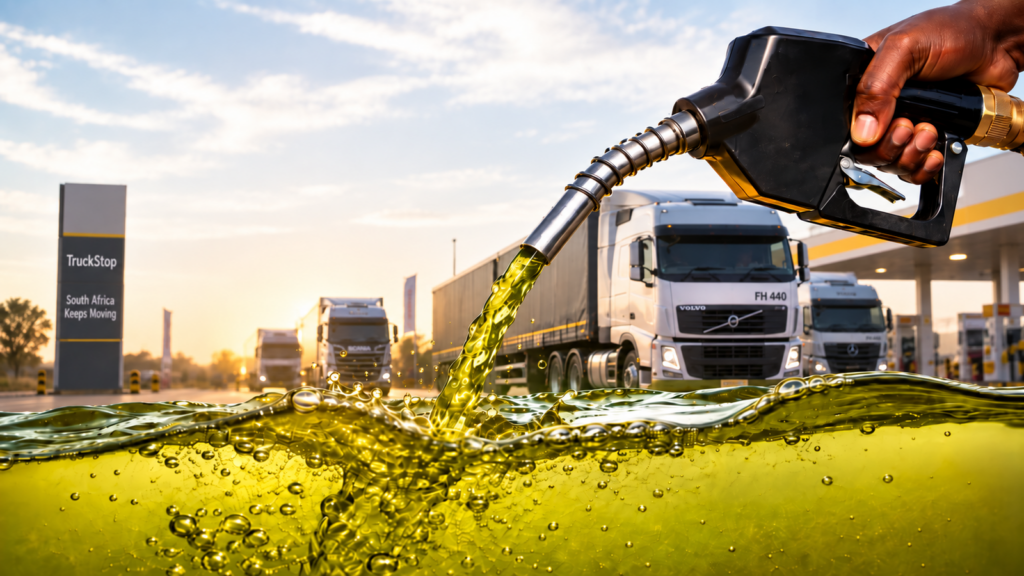
South Africa may soon struggle to find a steady supply of diesel for its motorists due to the war in Iran and a new policy implemented by Russia.
Earlier this month, Russian President Vladimir Putin officially announced that the northern European country was suspending diesel exports to protect and restore its domestic capacity.
This declaration was made following several Ukrainian drone strikes, which disrupted Russia’s fuel production.
Russia has the capacity to produce up to 7 million barrels of diesel per day. However, its seaborne diesel exports dropped to just 187,000 barrels per day, down from 535,000 barrels per day one year prior.
Consequently, on 8 July, Putin announced that the country would ban diesel exports until 31 July.
Last year, Russia was responsible for 11% of global diesel exports, with Turkey and Brazil being its largest customers, followed by Africa.
Russia’s diesel export ban announcement caused benchmark European diesel margins to soar to a record $60.17 per barrel, significantly raising the price of importing the fuel.
This puts South Africa in a precarious position, as it has no natural crude oil reserves of its own and little refining capacity for diesel. The country is therefore highly dependent on imported diesel.
Russia’s diesel ban is compounded by the pressure on global fuel supplies caused by the war in the Middle East, which has escalated again following a breakdown in negotiations between Iran and the US.
When the war began, the closure of the Strait of Hormuz caused global diesel supplies to drop by 13%, resulting in record price increases.
The Strait was reopened on 17 June, leading to temporary relief, but the collapse in negotiations and renewed fighting is quickly undoing this progress.
As a result, it is looking increasingly likely that the price of diesel will increase in South Africa this August, despite earlier reports from the Central Energy Fund indicating that prices would drop by up to R5 per litre.
South Africa does not directly import diesel from Russia. However, the loss of one of the world’s largest producers is expected to cause demand and prices to skyrocket as supplies are constrained.
South Africa imports both crude oil and refined fuel products at international price benchmarks. Diesel prices are benchmarked at 50% Mediterranean and 50% Arabian Gulf.
“Both reference markets sit inside the affected region caught in these two major developments,” the Centre for Risk Analysis (CRA) warned. “A renewed Iran conflict raises the dollar price of the benchmark.”
“A prolonged Russian diesel absence removes a large volume of physical supply that would otherwise have relieved that pressure.”
Minister says there are no diesel shortages in South Africa – Fuel stations reported otherwise

The concerns over global oil supplies have reignited debates in South Africa about the country’s own fuel stores, which are believed to be worryingly low.
The government reportedly has no reliable data on the country’s current fuel stock levels, with only rough estimates on its strategic reserves.
Yet even these estimates show that South Africa’s strategic reserves are far below both domestic and international standards and policies.
A month after the war in Iran broke out, Minister of Mineral and Petroleum Resources Gwede Mantashe addressed concerns about potential fuel shortages.
At the time, the minister claimed that South Africa’s longstanding ties with Iran had enabled South African cargo ships to pass through the Strait of Hormuz.
Despite these claims, several fuel stations started reporting shortages soon after, raising questions about the country’s reserves.
Mantashe was quick to dismiss rumours of a potential fuel shortage, saying that South Africa had adequate reserve fuel stocks.
“There’s no shortage of petrol, oil or diesel in the country,” Mantashe said. “It is just expensive. That is the function of the price.”
“But in terms of supply, it is available because we are not an enemy of Iran. That is what saved us. The issue is price, and that is not in our control.”
When these comments were made, the Central Energy Fund reported that South Africa had around 8 million barrels of strategic crude oil reserves, but no refined fuel reserves.
This equates to roughly two weeks’ worth of potential fuel, well below the legally mandated minimum requirement of two months of strategic fuel reserves.
Since then, it’s been unclear whether South Africa has moved to bolster its fuel stockpile, leaving concerns about shortages on the table.
“If the ceasefire fails to hold and Russia’s ban extends past 31 July, expect a sharp upward correction in the August Basic Fuel Price, with diesel moving more than petrol,” the CRA warned.
“Transport, logistics, mining and commercial agriculture will feel this first. That Russia will start importing fuel in July suggests Moscow expects the domestic shortage to persist beyond its own refining recovery.”



 Loading ...