


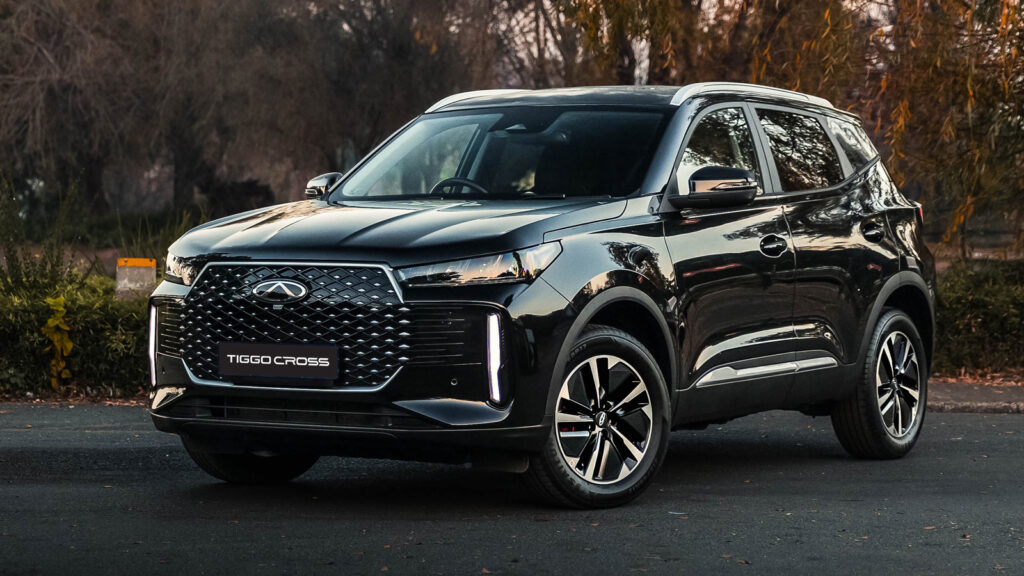
Chinese car brands have officially transitioned from budget niche challengers to mainstream market leaders, and now make up nearly a quarter of all cars sold in South Africa.
This is according to the 2026 Cars.co.za Industry Report, which combined data from its own platform, TransUnion, and Absa, showing that Chinese car brands now command over 22% of the market share.
Overall, the local automotive market has remained resilient, despite global headwinds like fuel prices and market uncertainty, largely thanks to the vehicle-pricing environment, supported by low-cost Chinese offerings.
New vehicle inflation remained low, at around 0.6% year-on-year during the second quarter of 2026, while used vehicle prices remained in deflationary territory.
According to the report, this has helped support affordability despite rising fuel prices, borrowing costs and broader household expenses.
The local market has also become much more competitive, as Chinese manufacturers continue to gain significant market share.
Sales of these vehicles increased 72% year-on-year during the quarter, compared with just 3% growth among traditional original equipment manufacturer (OEM) competitors.
“The significance of this trend is no longer the arrival of Chinese brands, but their growing scale,” the report reads.
“Expanding dealer networks, broader model ranges and improved consumer acceptance are accelerating their transition from challengers to mainstream competitors.”
Chinese car brands are also no longer only competing with the established OEMs, but have also influenced the used-vehicle market.
“Competitive pricing, strong specifications and attractive warranty offerings are making many new Chinese vehicles viable alternatives to used vehicles from established brands, reshaping the traditional new-versus-used purchase decision,” the report notes.
As a result, China is now one of South Africa’s biggest suppliers of cars, with Chinese brand inventory on Cars.co.za rising from 1.27% of total listings in 2020 to 10.14% in 2026, ranking it fourth behind Japan, Germany, and the US.
The major players

Unsurprisingly, the Chery Group, comprising Chery, Jetour, Omoda and Jaecoo, recorded combined sales of 17,679 vehicles in the second quarter, establishing it as one of the country’s major players.
Much of this success boils down to the incredible performance of the Chery Tiggo 4 Pro, which, including the Cross variant, sold 11,322 units during the first half of 2026.
As a result, the Chinese crossover surged from sixth in the first half of 2025 to second this year, overtaking the Suzuki Swift, which held off the VW Polo Vivo as the best-selling car locally for a while.
According to the report, another big brand move is Jetour, which, with the T2 and T1 respectively, has shot into the Top 25 of car brands in South Africa.
Jetour recorded massive growth across different price categories, but dominated one segment in particular.
In the R700,000 to R1 million bracket, the Jetour T2 2.0T Odyssey claimed first place outright with a 16% lead share, displacing the long-standing Haval H6 GT and deepening the Chery-GWM rivalry.
That said, GWM remains a market anchor for Chinese bakkies, thanks to the sales performance of the P-Series, including the P300 and P500.
While Chinese penetration in bakkies is lower than in SUVs, it grew from 4.4% in 2023 to 11.2% in 2026, with GWM holding 6.5% of the overall market.
Speaking of bakkies, the plug-in hybrid (PHEV) BYD Shark holds third place in the R700,000 to R1 million bakkie bracket, with 13.81% of the lead share.
The Shenzhen-based automaker is also the local leader in the new-energy vehicle (NEV) and electric car (EV) segment dominated by Chinese brand offerings.
According to Cars.co.za, the BYD Dolphin Surf leads overall NEV model demand, the Geely E2 ranks as the top enquired individual EV variant, and brands not yet reporting to Naamsa are showing significant consumer demand.



 Loading ...

-2026.10.webp)

Conversation
6 commentsSometimes I feel like Chinese car brands are all I hear about. None of the other manufacturers seem to get nearly as much airtime.
I’m genuinely glad there is competition for the legacy manufacturers. Competition is good for consumers and forces established brands to improve. However, I do get the sense that Chinese manufacturers are spending heavily on advertising, influencers and social media creators, and we hear far more about the features and value than we do about the potential downsides.
What about long-term parts availability, resale value, electronics reliability and support for models that are being replaced very quickly? Many of these vehicles come packed with electronics and technology, which looks fantastic when the car is new, but I’m more interested in what ownership looks like after 8, 10 or 15 years.
Personally, I’m quite happy with my relatively analogue car that I can almost fix with a piece of wire. 😂
Good luck to the Chinese manufacturers. The real test for me will not be how impressive these cars are when they leave the showroom, but how well they age, how well the support networks develop, and how those electronics and batteries cope after years of heat and harsh African conditions.
Time will tell.