Since South Africa’s biggest airline, FlySafair, implemented a fuel surcharge on all its flights, flyers travelling from Johannesburg to Durban have been shielded more than those flying to and from Cape Town.
The airline was forced to implement temporary surcharges as a result of jet fuel prices rising rapidly during the Middle East conflicts between the USA and Iran.
At the time, Kirby Gordon, Chief Marketing Officer at FlySafair, explained that the airline hoped that it would be a short-term solution to a short-term crisis.
Because of the closure of the Strait of Hormuz, a passageway through which 20% of the world’s oil flows, Jet A1 fuel prices at South African coastal airports increased by approximately 70% in a single week.
As a result, South African airlines were forced to implement these surcharges, and extend them as the strait remained shut for months.
During this time, FlySafair published the surcharges on its website, as it aimed to “ensure fairness and transparency to customers”, and reviewed and adjusted them as fuel prices stabilised.
At first, these surcharges spiked heavily, climbing from an initial R90 per ticket from Johannesburg to Durban and R170 to fly between Cape Town and Johannesburg to R460 and R840 respectively.
Since then, however, prices have been decreasing gradually as global jet fuel supply and prices continue to stabilise.
Below is FlySafair’s chart documenting the movement of the dynamic fuel surcharges it has implemented since 12 March 2026.
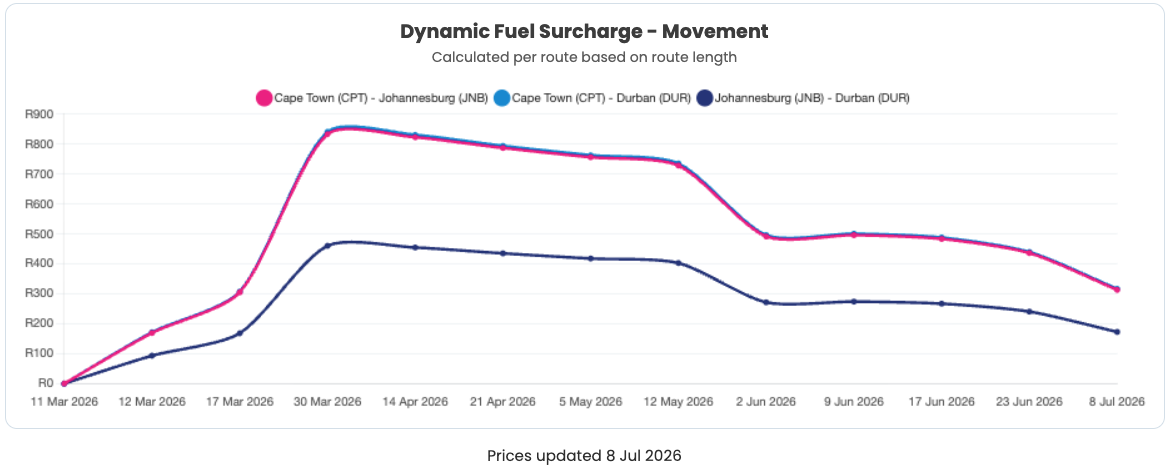
Flyers between Johannesburg and Durban have been spared the most price pain since March, while those flying to and from Cape Town from Johannesburg or Durban paying the most in fuel surcharges.
Flying between Johannesburg and Durban right now

Following the implementation of the fuel surcharges, Kirby explained that they would vary by route length to reflect the actual fuel consumption required per journey.
As such, it makes sense why flights between Johannesburg and Durban would incur a lower surcharge compared to flights from Joburg to Cape Town, and Cape Town to Durban.
Flight distances and times for South Africa’s major airports:
- Johannesburg to Durban – 478km, average flight time – 1 hour 10 minutes.
- Durban to Cape Town – 1,278km, average flight time – 2 hours 15 minutes.
- Cape Town to Johannesburg – 1,255km, average flight time – 2 hours 15 minutes.
The massive difference in distance between flying to Durban vs flying to Cape Town, means FlySafair’s surcharges look as follows:
| Route | Surcharge |
|---|---|
| Cape Town (CPT) – Durban (DUR) | R316.25 |
| Cape Town (CPT) – Johannesburg (JNB) | R312.80 |
| Johannesburg (JNB) – Durban (DUR) | R172.50 |
Gordon explained that the surcharges don’t act as a profit mechanism, and instead acts as a measure to maintain service continuity while being upfront with customers.
“Our teams are modelling fuel prices airport by airport and reviewing potential tankering strategies to ensure the surcharge reflects the minimum required amount,” he said.
Fuel makes up around half of FlySafair’s direct operating costs, and while the airline absorbed the price increases at the beginning, it became unsustainable.
The airline has also never implemented a surcharge before, something it said many global carriers have done at times.
Instead, FlySafair has kept pricing as straightforward as possible and avoided passing through fuel volatility to customers.
Gordon explained that the airline has highlighted the surcharges on tickets to maintain full visibility, and will remove the surcharge once prices stabilise.





 Loading ...