


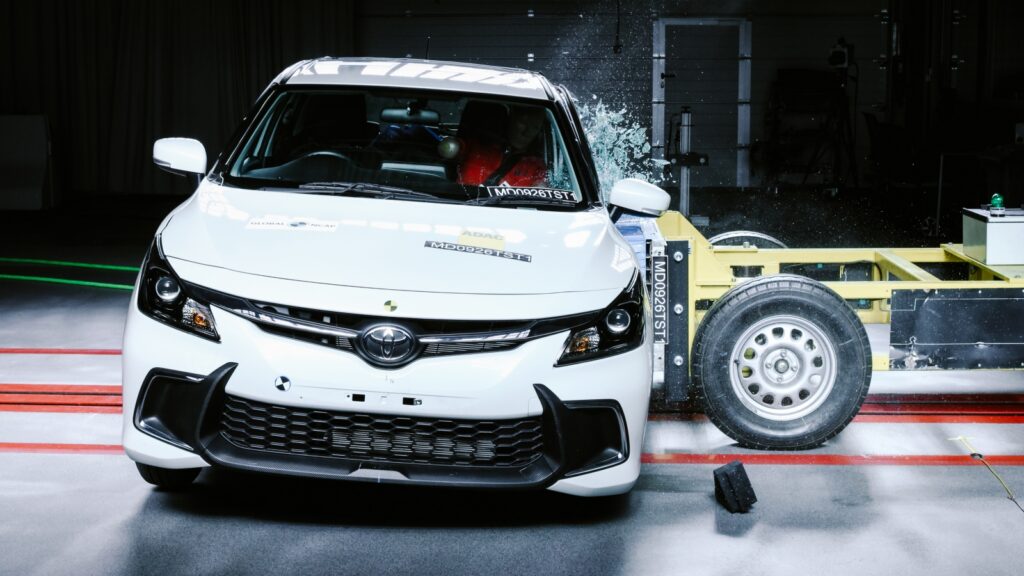
The South African government has gazetted the Draft Compulsory Specification for Motor Vehicles of Category M1, which proposes new safety standards for all new passenger cars sold in the local market.
The Automobile Association (AA) of South Africa welcomed the publication issued on 10 July 2026 for public comment before 10 September 2026.
It insisted these new standards be implemented across all derivatives and spec levels sold in South Africa.
“The AA welcomes the gazetting of the updated airbag requirement, a result of the campaigning the AA has undertaken for many years now under the banner of SaferCarsForAfrica,” it said.
“Airbag protection for all occupants will lead to safer cars, especially in the entry-level space, which the AA has observed as the cost point at which local manufacturers and distributors tick as few safety boxes as possible.”
The association noted that it requires side and curtain airbag protection for consumers, adding that if a minimum of four airbags are required, curtain protection should be part of the additional airbag installation.
Additional published changes include adding side impact protection as a mandatory requirement, which the AA has repeatedly cited as a concern, lobbying for its inclusion for decades.
“We further welcome the inclusion of Electronic Stability Control (“ESC”) within the proposed safety requirements and stipulate that ESC be made mandatory across all specification levels of newly introduced vehicles locally,” the AA said.
“Electronic Stability Control is a key component of vehicle safety and stability and has been widely recognised as an important technology in reducing the risk and severity of certain crashes.”
Following the comment period is a review before the new legislation can be implemented. However, once they are gazetted, manufacturers will have six months to ensure all models adhere to the revised safety standards.
“As the Automobile Association, we view this as the culmination of decades of fighting for consumer safety in the mobility space,” the association said.
A long road to better vehicle safety

For years, the AA of South Africa has been pushing for legislative changes that would make vehicles across all specifications safer.
“Road safety is not merely a policy priority; it is a shared global responsibility. The AA has long championed best practices in mobility, and our commitment extends beyond advocacy,” it said.
“We focus on translating principles into meaningful action, and our partnerships reflect that approach.”
Part of its advocacy is subjecting entry-level vehicles sold in South Africa to testing alongside the Global New Car Assessment Program (GNCAP).
These entry-level cars are purchased independently before being submitted to frontal and side-impact occupant safety tests.
Examples include the entry-level versions of the Hyundai Grand i10, Kia Sonet, Haval Jolion, and Toyota Starlet, all of which scored less than 3 stars for adult occupant safety, which the AA considers the bare minimum.
According to Ramagwede, cars sold in Africa are held to a much lower safety standard than those sold in regions like Australia and Europe, which is why the AA has been pushing for local reform.
“We will ensure that the revised standards feature our prescribed minimums to ensure the effectiveness of the reforms,” said Ramagwede.
Alongside the new reforms that mandate additional safety equipment on entry-level cars, the AA wants to establish a dedicated African NCAP to crash-test all cars sold on the continent.
“These amendments will contribute to improved NCAP vehicle safety ratings, bringing South Africa more closely into alignment with other markets which for years have insisted on these basic safety requirements,” the association said.



 Loading ...
-2026.10.webp)


-2026.10.webp)
Conversation
5 commentsRequiring all of the different airbags and ESC is a total overkill. Basic head on collision airbags are all what is really required. The rest are all luxury add on’s.
If our road users acted as they should on our roads and if our traffic policing was what it should be, we would not have to incur additional costs the the intended add on’s.
It is maybe time the AA put the pressure on law enforcement to do their jobs and get the transgressors off our roads. We just need a few impounds of motor vehicles and really heavy fines and people losing their licenses then the behaviour on our roads may change.