Red flags over Jetour’s sudden T1 and T2 payload increases


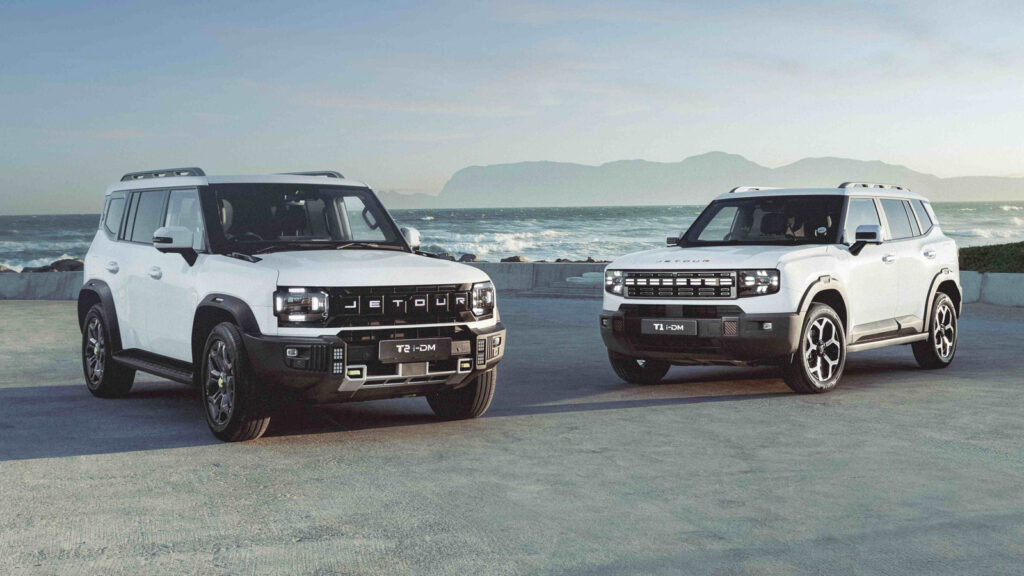
The Automobile Association (AA) of South Africa has noted Jetour’s recent submission confirming updated payload capacities of the Jetour T1 and T2, but has questioned how this is possible.
The Chinese automaker, a Chery sub-brand, announced that both of the popular SUVs have seen their payload capacities uprated by the National Regulator for Compulsory Specifications (NRCS).
Before this, the cars had an unusually low payload capacity of 300kg to 375kg, depending on the variant, and now boast approved payloads of 475kg, inclusive of the driver.
Jetour confirmed that insofar as the relevant vehicle falls within the model range and specifications covered by the NRCS approval, the revised payload capacity applies to new and existing T1 and T2 models in the local market.
That said, the AA has questioned how the NRCS approved the increase if no mechanical, structural or component changes were made to the applicable T1 or T2 models.
It added that the new rating relates to the vehicles “in their existing mechanical and structural configuration”.
In response to concerns raised by the AA, the National Regulator explained that the two models were approved based on the submitted documented evidence of compliance.
This included the whole-vehicle-type approval brake test report, which provided for the axle load capacity and Gross Vehicle Mass design capacity with a payload rating of 375kg.
During the vehicle homologation inspection, it was verified that the vehicle manufacturer’s data plate and the technical information contained in the Notification of Vehicle Model form matched the technical information.
“There are no (subsequent) structural changes on the vehicle; however, the submitted brake test report covers those (updated) changes,” the NRCS told the AA.
“This process is followed whenever there are changes in the approved vehicle model where safety compliance is likely to be impacted by the changes. The process caters for the addition of variants and also for corrections.”
Questions over payload capacity remain

As a result of the sudden, untested payload capacity increases, the AA has questioned whether the NRCS should grant these approvals, since relying on supplied data is the equivalent of automakers ‘marking their own homework’.
“It is simply not good enough, without independent testing and evaluation, for such a safety-critical approval to have taken place – be it at initial homologation or subsequent rating amendments,” the AA said.
It also asked how a payload can be revised with zero vehicle modifications applied to accommodate the increased payload capacity.
“This poses a significant safety risk to T1 and T2 occupants – a payload capacity cannot simply increase by almost 200kg with zero attention to structural integrity,” it added.
“The AA questions the validity of local licensing authorities engaging with the automaker on an issue that poses real safety risks to consumers.”
According to the association, this is an issue that does not make sense, either mechanically or procedurally.
As a result, it called on the NRCS to suspend approval of the uprated payload rating of 475kg pending a deeper investigation into both the initial 300kg rating and independent validation of the updated rating.
It also called on licensing authorities to cease engagement with the carmaker and on customers to be vigilant about both the initial and updated load capacities of both models.
“We appeal to the NRCS to institute independent testing and safety evaluation of all vehicles being introduced locally as a matter of urgency,” the association said.
It reminded motorists to be cognisant of TARE, Payload and Gross Vehicle Mass (GVM) ratings and the impact they have on daily vehicle usage.
“Exceeding the stipulated ratings will negatively affect the safety of the vehicle, forcing the vehicle to perform outside its rated parameters, which could lead to compromised handling and braking characteristics,” explained the AA.





 Loading ...