


Two of South Africa’s largest automakers are facing economic pressures that could spell the end for their local factories.
Nissan and Mercedes-Benz are two of the country’s seven legacy original equipment manufacturers (OEMs) that have production facilities within our borders.
Nissan has a plant located in Rosslyn on the outskirts of Pretoria in Gauteng, which produces the Navara bakkie.
Mercedes, on the other hand, is based in East London in the Eastern Cape, where it assembles the luxurious C-Class sedan.
Both of these factories are valuable assets to the economy, contributing to the country’s GDP while also providing thousands of jobs for local residents.
Unfortunately, both sites are reportedly at risk, owing to global economic factors affecting their business prospects.
Nissan

Earlier this year, Nissan revealed that it has plans to shutter as many as seven of its factories around the world.
The Japanese publication Yomiuri reported that two of the sites are located in Nissan’s home country, while the others are located in Argentina, India, Mexico, and South Africa.
The drastic decision is the culmination of Nissan’s well-documented financial issues, as the company has been in dire straits for a number of years.
The downward trend is largely attributed to the brand’s limited and ageing vehicle lineup, which is rapidly losing market share to newer brands, especially those from China.
Nissan previously attempted to merge with Honda to address these concerns, but talks between the two automakers ultimately fell through.
As a result, Nissan appears to be going through with its plan to shut down multiple factories, as it recently confirmed that Oppama, one of its largest domestic plants, will cease production by 2028.
The carmaker experienced a net loss of 670.8 billion yen (R85 billion) in its last financial report, its third-largest loss on record.
Consequently, Nissan is looking to lay off up to 20,000 employees and reduce its global production network from 17 to 10 factories in an effort to regain profitibility.
Nissan South Africa has neither confirmed nor denied that its Navara facility is at risk of closing down.
“Regarding the recent reports on the potential closure of certain plants, Nissan wants to clarify that this news is speculative and not based on any official information of the company,” it said.
One cause for hope is that Africa is considered to be a key market for Nissan’s growth prospects, and the practical Navara bakkie is a perfect fit for this environment.
It’s therefore possible that Nissan South Africa’s parent company may choose to spare the Rosslyn plant to expand to new markets and get its business back on track.
However, in the event that the Navara factory does close, it’s possible that another company could take over and prevent further job losses.
Most notably, Chery has expressed interest in establishing a manufacturing presence in South Africa, starting with a Research and Development Centre.
The company’s leadership expressed interest in the idea of a full-blown assembly plant, “if market conditions permit.”
It’s not unreasonable to think that Chery or another carmaker could take over Nissan’s operation, rather than establish an entirely new factory, should the opportunity present itself.
Mercedes-Benz

Earlier this month, MEC Mlungusi Mvoko revealed that Mercedes-Benz South Africa (MBSA) is worried about the prospects of its East London factory.
The Premier explained that MBSA has been hit particularly hard by the ongoing trade war with the United States, which implemented a 25% import tariff in April, on top of a 10% universal tariff.
Now, the USA is set to impose an additional 30% tariff on South African exports on Friday, 1 August 2025.
The impact of these tariffs has been felt across the local auto sector, as the National Association of Automobile Manufacturers of South Africa has reported that vehicle exports to the United States declined by 82% in the first half of 2025.
However, some OEMs have been hit harder than others, as not all companies export to the same markets.
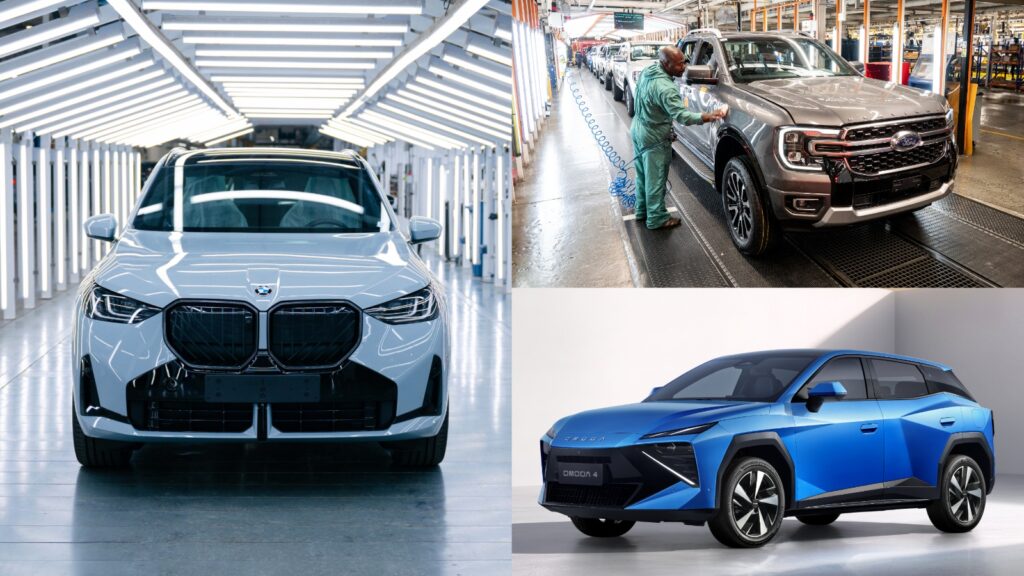
VW and Ford, for example, primarily export to the United Kingdom and the European Union and are therefore less affected by the tariffs on models shipped to America.
BMW recently announced that it plans to get around this issue by exporting the X3 SUV to Canada rather than the United States.
This is a rather unique situation for BMW, however, as Canada usually receives the X3 from the US, but the deteriorating relationship between the two North American nations means Canada is now willing to source its imports from other markets like South Africa.
Things are a lot trickier for MBSA, as the USA is one of its biggest markets, yet it doesn’t appear to have an alternative like BMW.
In light of this, the company reportedly told Mvoko that it may have to close its Eastern Cape plant.
“You cannot imagine East London without Mercedes-Benz, MBSA exports almost 90% of their cars to the US. In our interaction with them, they said that given these tariffs, it would be difficult,” said the Premier.
Importantly, these reports are not final, and the company is allegedly looking at new export markets that it could shift production towards.




 Loading ...