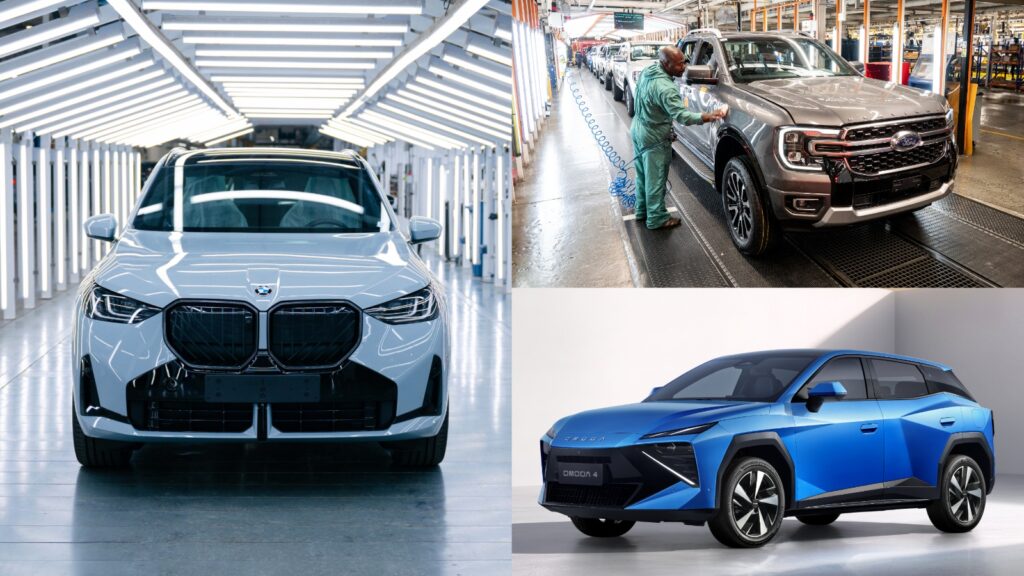
BMW South Africa has found a way to protect its business in the wake of the United States’ new tariffs on automotive exports.
Earlier this year, the US implemented a series of trade tariffs on several countries, including a 10% universal tariff and a 25% tariff on certain goods.
This has severely impacted South Africa’s car industry, as vehicle exports to America plummeted 82% in the first half of 2025.
Making matters worse is the fact that the tariffs are now set to go up even further, as the Trump administration declared on Thursday, 1 August 2025 that it would impose an additional 30% tariff on South African imports – the highest of any country in sub-Saharan Africa.
This has left many concerned about the future of South Africa’s auto sector, with President Cyril Ramaphosa vowing to protect manufacturing jobs threatened by the new economic conditions.
However, one company that is largely unaffected by the tariffs is BMW, which has found a way to protect its export goals for the foreseeable future.
As a reminder, BMW’s local division has a factory in Rosslyn on the outskirts of Pretoria in Gauteng, which manufactures the fan-favourite X3 SUV for local and international markets.
In a recent interview with News24, BMW SA CEO Peter van Binsbergen explained that the company has managed to secure Canada as a new export market for the X3.
He said that Canada traditionally obtained the X3 from BMW’s factory in the United States, and that North America has never been a big market for the Rosslyn plant.
However, the ongoing trade war has soured relations between the US and Canada, and the latter is now open to the idea of importing goods from other markets.
“Because of the punitive tariffs between the US and Canada, Canada has now asked us to produce vehicles for them,” Van Binsbergen said in the interview.
“We never sold [X3s] to Canada before because they got them from the States, but they’re going to be delivered from South Africa in the future. This year, we might see South African-made X3s go to Canada.”
Unfortunately, the CEO was not able to disclose the number of units they expect to send to North America.
It’s worth noting that BMW South Africa is already in a unique position as a global exporter, as it is the sole manufacturer of the new X3 plug-in hybrid.
Hybrid sales are an increasingly important segment for automakers, which puts the Rosslyn factory in good stead for future support.
The facility has a production capacity of roughly 79,000 units per annum, running 24 hours per day with employees operating on a three-shift cycle.
Not as lucky

Unfortunately, while BMW’s future in South Africa appears to be secure for the time being, the same cannot be said for two other factories.
Nissan’s plant in Rosslyn and Mercedes-Benz’s plant in East London are both reportedly at risk, albeit for different reasons.
Nissan has been facing financial issues for several years, and the automaker is now planning to lay off 20,000 employees and close seven of its factories around the world.
This includes two sites in Japan, as well as locations in Argentina, India, Mexico, and South Africa.
The company’s local division has neither confirmed nor denied that its factory is facing closure, but it’s possible that it may still pull through.
Nissan previously stated that Africa is central to its growth prospects, and Rosslyn produces the rugged Navara bakkie, which means it’s probably in the company’s best interests to keep the site to help with its financial recovery.
As for Mercedes, its East London facility has been hit hard by the new trade tariffs, as 90% of the C-Class sedans produced there are shipped to the US.
As a result, MEC Mlungusi Mvoko warned that Mercedes-Benz South Africa (MBSA) is worried about the site’s future.
“You cannot imagine East London without Mercedes-Benz, MBSA exports almost 90% of their cars to the US. In our interaction with them, they said that given these tariffs, it would be difficult,” said the Premier.
The company is allegedly exploring the prospect of opening up new export markets to solve this problem.




 Loading ...