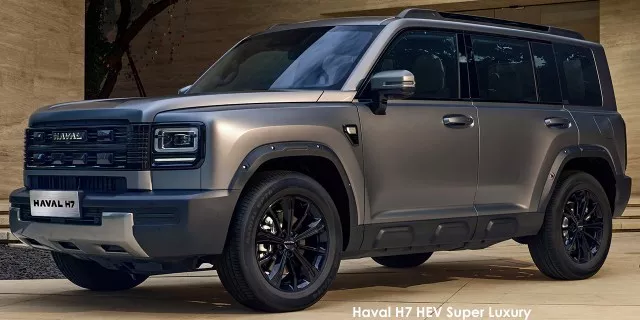
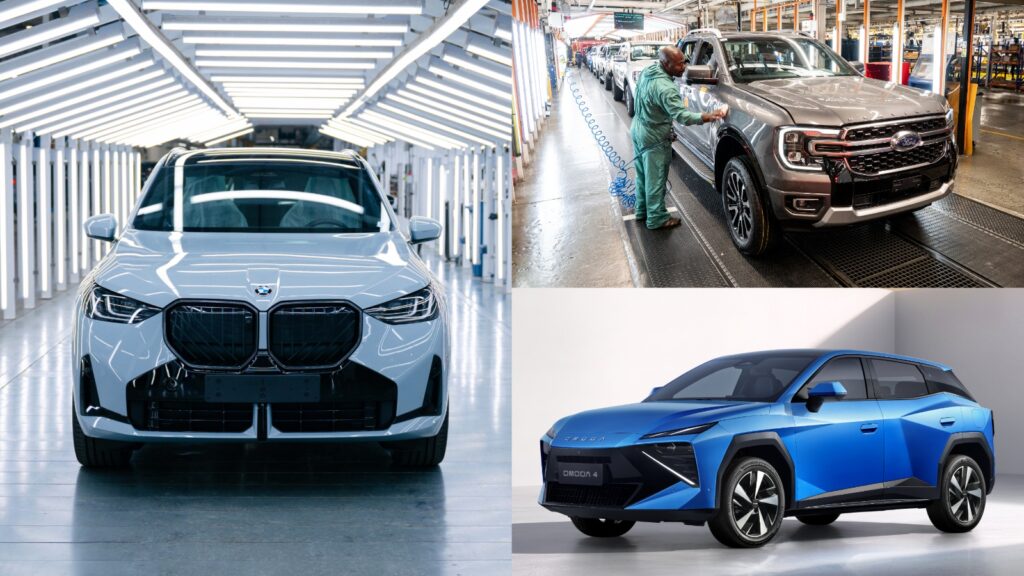
At least four new cars are set to be built in South Africa over the next few years, comprising two bakkies, a 4×4 SUV, and an entry-level crossover.
South Africa currently has seven legacy original equipment manufacturers (OEMs): Ford, VW, Mercedes-Benz, BMW, Nissan, Toyota, and Isuzu.
However, other carmakers have started to invest billions of rands to set up their own local assembly operations.
Mahindra, for example, has a plant at the Dube TradePort Special Economic Zone (SEZ) in KwaZulu-Natal, which has been producing the Pik Up bakkie from semi-knock-down kits since 2018.
Back in August, the Indian automaker opened a new facility to complement the original, expanding production to meet growing demand.
Mahindra is not the only company that is investing in South Africa, however, as BAIC, Foton, Peugeot, and VW have all announced plans to construct a new vehicle within our borders.
BAIC B30

The Chinese manufacturer BAIC (Beijing Automotive Industry Corporation) has a facility in the Coega SEZ on the outskirts of Gqeberha in the Eastern Cape.
The site currently produced the Beijing X55 Plus crossover and the B40 Plus SUV, but the company recently announced it will add a third model to the list – the B30.
Scheduled to go on sale this November, the B30 is the brand’s latest 4×4 SUV and is set to slot below the R669,500 B40 with an indicative starting price of around R550,000.
“In line with BAIC’s global “Build Where We Sell” philosophy, the localisation of the B30 strengthens the brand’s supply-chain resilience, reduces import dependency, and opens opportunities for future component sourcing through South African suppliers,” said the company.
“The inclusion of the new B30 SUV will expand capacity and sustain hundreds of local jobs across production, logistics, and dealership networks.”
Foton Tunland G7

Foton is a subsidiary of BAIC that produces commercial vehicles, including bakkies.
The brand launched in South Africa last year with its first product, the Tunland G7, which quickly became one of the nation’s top-selling pickups.
Earlier this year, Foton announced that it would build the G7 in South Africa, a promise that came to fruition last month
In late September, the carmaker declared that it had built its first pre-production model at BAIC’s factory in the Eastern Cape.
The vehicle was built from a full-knock-down kit, meaning all of the parts are shipped to the site from China to be assembled into the final product.
Full-scale production is set to kick off in the near future, and Foton plans to add new vehicles to its assembly line over the coming years, such as the Tunland V9.
Peugeot Landtrek

Stellantis, the parent company of Peugeot, Opel, and several other car brands, is currently building a R3-billion factory at the Coega SEZ in the Eastern Cape.
The vehicle chosen for this new site is the Peugeot Landtrek, a midsize bakkie that has been on sale in South Africa for a few years.
The company explained that it plans to use the site to grow its presence across the MEA (Middle East and Africa) region, and that the Landtrek is the ideal candidate given the demand for bakkies in these markets.
Production is scheduled to begin in 2026, but Stellantis is already thinking of adding a second vehicle to the site to cater to changing market conditions.
Unfortunately, it did not provide any further details on what vehicle this could be.
Given Stellantis’s vast catalogue, the new model could be anything from a Jeep to a Citroen or an Opel.
VW Tengo

Last but not least is VW, which plans to add a new model to its Kariega plant in the Eastern Cape.
The site currently produces the Polo and Polo Vivo, but this will be expanded to include a new crossover called the Tengo.
The move is part of a plan to address VW’s slowing sales in South Africa, as most of its catalogue is now considered unaffordable for the average salary.
Its cheapest SUV, the T-Cross, now starts at R399,900, so VW South Africa looked to other markets to find a solution.
In Brazil, VW sells a small crossover called the Tera, which is significantly cheaper than the T-Cross.
VW South Africa has, therefore, decided to bring the Tera to our shores under a different name – the Tengo – to regain a foothold in the entry-level SUV segment.
The Tengo will be built at Kariega, though production is only scheduled to begin in 2027, so it will be quite a wait before we get our hands on this one.




 Loading ...