
The major carmaker moving away from petrol and diesel in South Africa


The most popular carmaker in South Africa – Toyota – is making a push towards greener mobility through the development of a Mobile Hydrogen Refuelling Station at North West University (NWU).
Toyota South Africa Motors (TSAM), alongside the Department of Science, Technology and Innovation (DSTI) and Hydrogen South Africa (HySA), launched the project in a bid to achieve local long-term net-zero ambitions.
The refuelling station supports local advancement of green hydrogen mobility, particularly for commercial transport applications.
During the handover, Toyota also used the station as a live demonstration platform for hydrogen fuel cell electric vehicle technology, which it showcased through the Toyota Mirai.
The initiative reinforces the Japanese automaker’s commitment to a multi-pathway approach to carbon neutrality in South Africa.
It hopes to achieve this using a mix of available technologies, including hybrid cars (HEVs), plug-in hybrids (PHEVs), battery electric vehicles (BEVs), and now also fuel cell electric vehicles (FCEVs).
Anton Smalberger, Senior Manager for New Energy Business Development at TSAM, said that hydrogen is an important part of the brand’s multi-pathway strategy for achieving carbon neutrality.
“This milestone is not only about new technology but about building a viable hydrogen ecosystem that is safe, standards‑compliant and suitable for South African conditions,” he said.
“As a company, we are happy to support the government’s goals towards the decarbonisation of the transport sector.”
The hydrogen refuelling station was developed using local engineering expertise and complies with local and international standards.
According to Toyota, this underscores its readiness for commercial application in South Africa, as well as its role in building a credible hydrogen mobility ecosystem.
“Hydrogen commercialisation requires collaboration, patience and credibility,” added Smalberger.
“This project demonstrates that South Africa can move from research to reality and that Toyota is committed to being part of that journey in support of the country’s just energy transition.”
The Toyota not yet available in South Africa
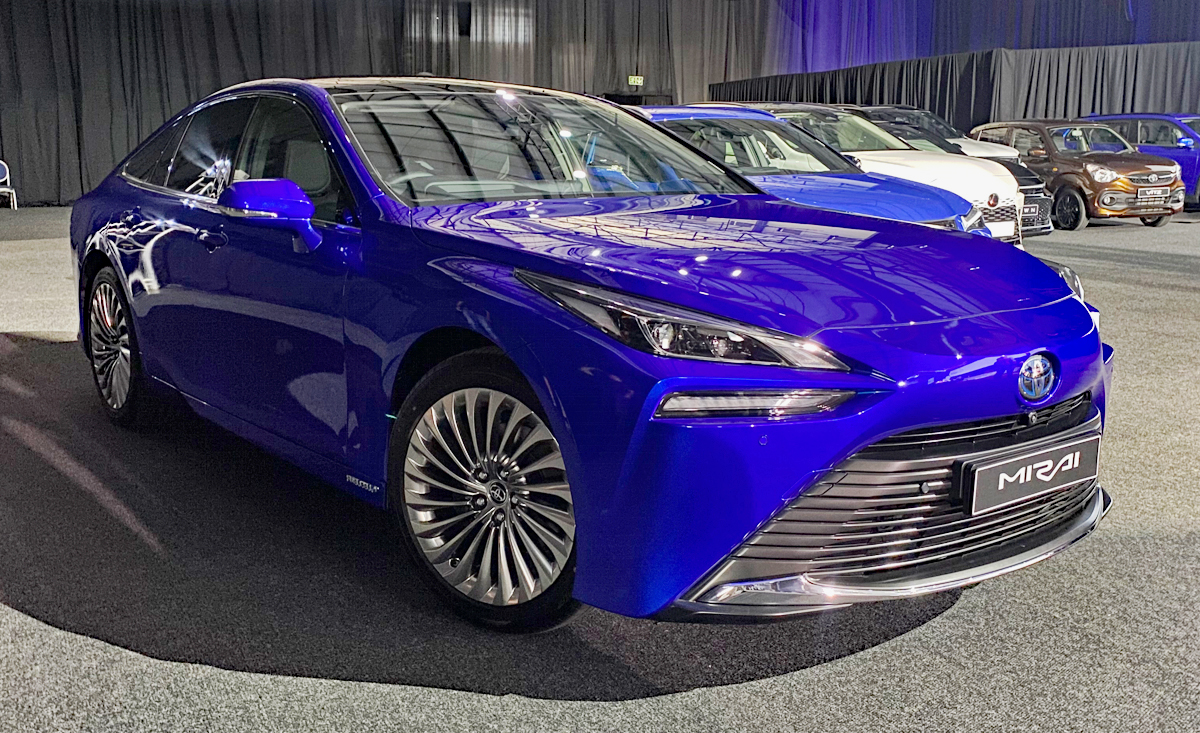
The first-generation Mirai sedan was launched in 2014, acting as Toyota’s catalyst for global awareness of the future of clean and sustainable hydrogen mobility.
Hydrogen fuel cells are considered clean, as their only products are electricity, water, and heat.
They also operate more efficiently than combustion engines and can convert the chemical energy in the fuel directly to electrical energy with efficiencies capable of exceeding 60%
Hydrogen fuel cells emit only water, addressing critical climate challenges, as there are no carbon dioxide emissions.
The first-generation Mirai was also a practical vehicle, with a driving range of around 500km and easy refuelling in minutes, making it a popular choice that sold more than 10,000 units.
In 2020, Toyota introduced the second-generation Mirai in Japan, North America, and Europe – areas supported by refuelling infrastructure.
This version was designed to demonstrate how Toyota’s FCEV technology can help create a vehicle that it calls “rewarding to drive”.
Toyota targeted a 30% increase in the second-generation Mirai’s driving range through improvements to the fuel-cell system and larger on-board hydrogen tanks.
The sedan was never introduced to the local market, which TSAM Senior Vice President of Sales and Marketing Leon Theron confirmed at the 2023 State of the Motor Industry (SOMI) event.
“However, showcasing the FCEV Mirai on African soil allows TSAM to undertake local research and include other relevant players in this field, while at the same time helping the government to see the potential of a Green Hydrogen Society,” he said.
“TSAM’s ongoing collaboration with Sasol, for example, on green hydrogen will take a step forward, now that we have these FCEVs in our hands, but we will elaborate on this at future events.”
It remains to be seen if Toyota’s increased investment in local green hydrogen refuelling stations will lead to the local introduction of vehicles like the Mirai.
The sedan currently retails for $51,795, or R864,500, but local prices would almost certainly be higher than this.




 Loading ...
-2026.10.webp)


-2026.10.webp)