
South African carmakers under siege by Chinese and Indian brands



The automotive sector in South Africa is staring down a considerable shift in trade due to the market penetration of Indian and Chinese vehicles.
More affordable vehicles from these Asian markets have expanded consumer choice and improved affordability in an increasingly price-sensitive economy.
However, rising imports have intensified competition for domestic producers, contributing to the growing concerns regarding the long-term trajectory of the local automotive sector.
This is according to the Bureau for Economic Research’s (BER’s) economist Rose Murunzi, who highlighted concerns regarding local automotive-sector manufacturing, investment and employment.
“South Africa’s automotive sector is undergoing a noticeable shift in its trade and market structure,” she explained.
“Import penetration has increased, and while India has long been an important supplier of affordable passenger vehicles to South Africa, Chinese brands have expanded particularly rapidly in recent years, increasing their share of the domestic market.”
At the same time, South Africa’s auto industry continues to contend with structural constraints, infrastructure inefficiencies and high logistics costs.
The stark contrast in manufacturing scale and the resulting trade deficit highlights the difference between local and Asian production capacity.
In 2025, South Africa accounted for merely 0.64% of global vehicle production, while India accounted for around 6.4% of global production, ranking fourth overall, and China accounted for about 33.7%, ranking first.
In the same year, South Africa recorded a total automotive trade deficit of R66.5 billion, with its automotive trade deficit with Asia alone amounting to a total of R143.5 billion.
Murunzi noted that this highlights the automotive sector’s heavy reliance on Asian vehicle and component imports and lack of exports to the region.
South Africa’s largest automotive trade deficit by country was with China at R57.7 billion, followed by Thailand with R34.8 billion, and India at R32.1 billion.
In contrast, South Africa has been India’s largest export destination for passenger vehicles and its second-largest destination for commercial vehicles for over a decade.
The manufacturing cost advantage in Asia
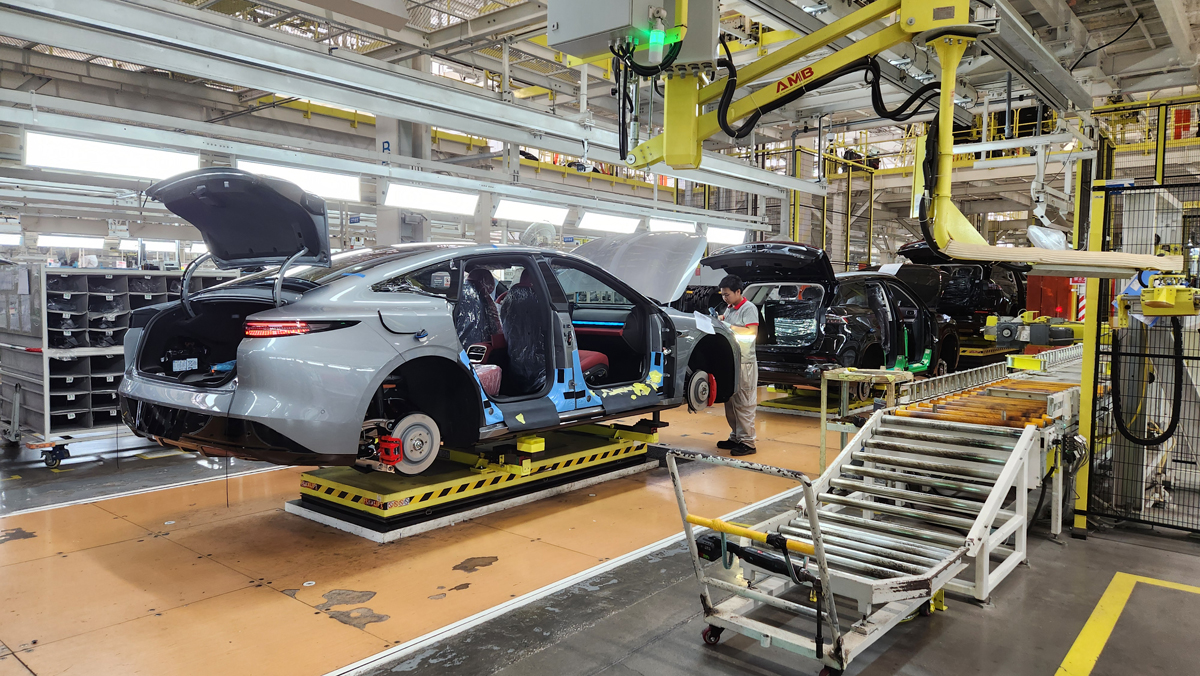
Asian automotive industries, particularly India and China, have achieved high production levels thanks to strong state support and deep supplier networks.
Murunzi explained that this scale differential translates directly into cost advantages, enabling both markets to undercut global competitors while maintaining margins.
Additionally, weak economic growth has made local consumers increasingly price-sensitive, which has benefited Chinese and Indian carmakers.
According to the Automotive Business Council (Naamsa) 2026 Automotive Trade Manual, last year’s market activity was concentrated within a pricing “sweet spot” of between R350,000 and R400,000.
This has played right into the hands of lower-cost import brands, which offer several options within this price bracket, at prices around 25% less than their locally manufactured rivals, as can be seen below.
| Segment | Asian car | Manufactured locally | Price differential |
|---|---|---|---|
| Entry-level hatchback | Suzuki Swift (R227,000) | VW Polo Vivo (R271,000) | R44,000 (16%) |
| Mid SUV | Chery Tiggo Cross (R309,000) | Toyota Corolla Cross (R420,000) | R111,000 (26%) |
| Premium SUV | Jetour T2 (R569,000) | Toyota Fortuner (R712,000) | R143,000 (25%) |
As a result, Chinese brands increased their local passenger-vehicle market share from 11.2% in 2024 to 16.8% in 2025.
While imported brands from China and India have expanded rapidly in South Africa, local vehicle production has grown slowly over the past 10 years.
The local automotive industry is operating below the Automotive Master Plan’s target of producing 1% of global vehicle output, which is equivalent to about 1.4 million vehicles annually.
In 2025, South Africa produced only 610,405 vehicles, meaning production was 56% below the industry’s long-term target.
Murunzi told 702 that understanding the sector’s constraints and developing strong policy is crucial to protecting local manufacturers.
She noted that it is essential to correct local production and its constraints, adding that it is “easy” to worry about the competition, but harder when the country does not have the correct environment to compete with them.






 Loading ...
-2026.10.webp)



-2026.10.webp)