New Volvo EX60 revealed – And it’s coming to South Africa


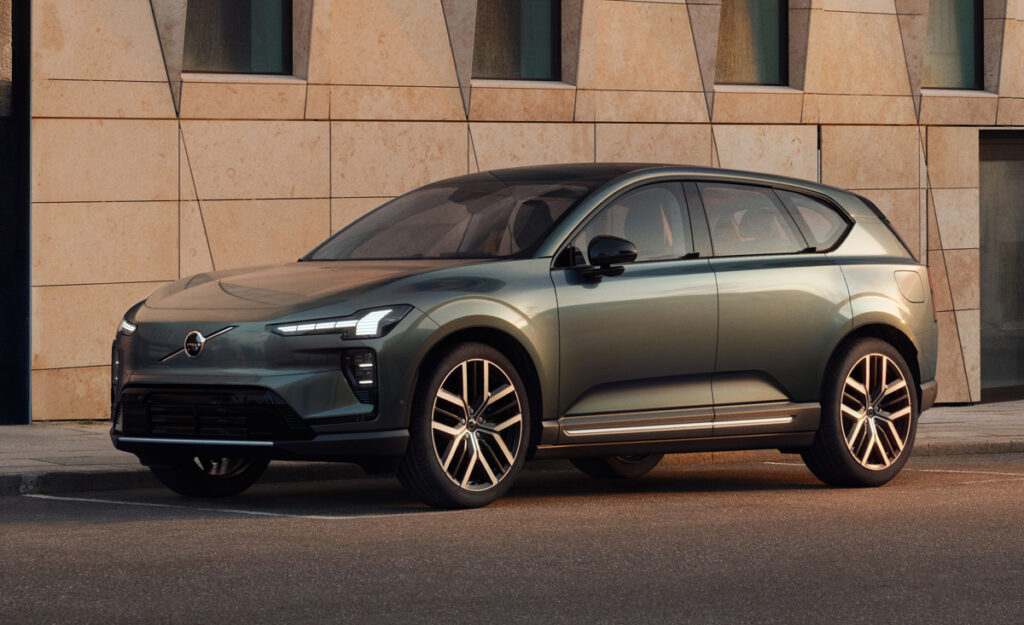
Volvo has finally unveiled the new EX60, and the good news is that it is coming to South Africa.
The carmaker pulled the covers off the new SUV this week, which is scheduled to go into production at Volvo Car’s factory in Sweden in the northern hemisphere’s springtime.
The company also confirmed that the EX60 will arrive in South Africa in the third quarter of 2026.
“The new, all-electric EX60 changes the game in terms of range, charging and price and represents a new beginning for Volvo Cars and our customers,” said Håkan Samuelsson, CEO of Volvo Cars.
“With this car, we remove all remaining obstacles for going electric. This fantastic new car is also a testament of what we are capable of at Volvo Cars, with an all-new product architecture introducing new key technologies – megacasting, cell-to-body and core computing.”
What to expect
The EX60 is the Swedish automaker’s new midsize electric SUV, slotting between the smaller EX30 crossover and the seven-seater EX90.
It should therefore come as little surprise to see that the new model’s styling is very similar to the other EX-badged units, with a closed-off front end and the same LED headlight and daytime running light signature.
It’s the same story at the back, with vertical LED taillights that flank both the lower boot door and the rear window.
In terms of size, the EX60 is 4,803mm long, 1,889mm wide and 1,639mm tall, splitting the difference between the EX30 and EX90, as expected:
| Dimension | Volvo EX30 | Volvo EX60 | Volvo EX90 |
|---|---|---|---|
| Length | 4,233mm | 4,803mm | 5,037mm |
| Width | 1,837mm | 1,889mm | 1,964mm |
| Height | 1,555mm | 1,639mm | 1,744mm |
The interior also follows the same template as the other EX models, with the notable exception of the infotainment screen, which opts for a landscape orientation when Volvo’s other cars use a portrait display.
The screen itself will feature Google’s Gemini AI assistant – a first for a Volvo – which was developed for the car in collaboration with Google, Nvidia, and Qualcomm Technologies.
Volvo stated that the new interface is its most responsive to date, with zero lag, instant loading for the navigation, and an AI voice assistant that users can have natural conversations with.
As for the cabin, it has a clean, minimalist aesthetic with a large multifunction steering wheel, and there’s a small digital instrument cluster on the dual dashboard.
Where the EX60 sets itself apart is with its new SPA3 electric platform, which can deliver a class-leading range of up to 810km, depending on the variant.
Volvo confirmed that the SUV will be offered with three powertrains, starting with the P6.
The P6 is equipped with a single rear-mounted electric motor with an output of 275kW and 480Nm, letting it accelerate from 0-100km/h in 5.9 seconds.
This version uses an 83kWh battery, which gives it a range of 620km.
Volvo also claimed that it is possible to add 340km of range in just 10 minutes when using a 400kW DC fast charger.
Next up is the P10, which has an all-wheel-drive (AWD) system with an e-motor over each axle.
The dual-motor setup means the P10 generates 375kW and 710Nm, which cuts the 0-100km/h time down to 4.6 seconds.
It also has a larger 95kWh power cell, which increases the range to 660km.
The top-of-the-line model, called the P12, also has an AWD configuration, but boasts an even higher reading of 500kW and 790Nm.
It is officially the most powerful production car Volvo has ever made, and can sprint to 100km/h in 3.9 seconds.
Thanks to a 117kWh battery, it also has a class-leading range of 810km.
Unfortunately, the company has yet to confirm the car’s trim levels and equipment sheet, so we’ll have to wait until Q3 to learn what each model has to offer.
Pricing is another unknown factor at this stage, though considering that the EX30 and EX90 start at R835,500 and R2,650,000, a reasonable estimate would put the EX60’s base sticker at between R1.2 million and R1.4 million.
Volvo EX60




 Loading ...