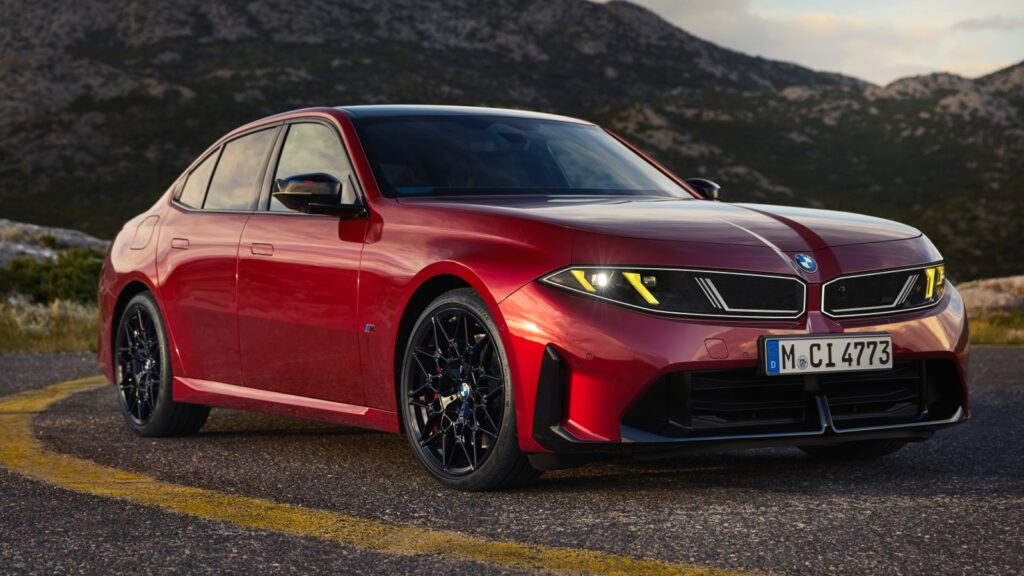
BMW plans to restore margins by simplifying its business, cutting costs and selling more expensive cars, according to analysts who took part in the company’s capital markets day.
The German automaker is trying to rebuild profitability after China’s ongoing price war, heavy spending on its electric-car overhaul and geopolitical upheaval squeezed returns.
Management is aiming to lift auto margins to 3% to 5% by 2028, and to its long-term target range of 8% to 10% early next decade, Bernstein analyst Stephen Reitman wrote Wednesday in a note.
Executives briefed analysts and investors Tuesday and will publish the updated financial goals later on Wednesday, the second and final day of the CMD in Munich.
“BMW has a pragmatic answer to the very volatile conditions,” Ingo Speich, head of sustainability and corporate governance at Deka Investment, said by email.
“Even BMW is not immune to the changes in the industry, even if it seemed that way for a long time.”
The shares rose as much as 3.5% in Frankfurt. They’re down about 40% this year, more than twice as much as the wider EURO STOXX Automobiles & Parts Index.
BMW had until recently stood out as the most resilient of Germany’s car manufacturers, helped by a flexible EV strategy and a premium-heavy lineup.
That distinction vanished with a major profit warning in June, as China’s deepening slump, fierce local competition and the huge cost of electrification hammered margins.
BMW and its European peers are facing stiff competition from upstart Chinese manufacturers at home, while also suffering steep declines in sales in China, the world’s biggest market.
That has deprived them of a lucrative revenue stream they relied on for years.
The challenge for Milan Nedeljkovic, the new chief executive officer, is to claw back returns while still funding the technology and new models it needs to stay competitive.
Among his first steps after taking over in May was cutting jobs by around 8,000, just over 5% of its workforce.
“BMW’s financial message is that 2026 is a transition year, with profitability expected to recover in stages,” Reitman wrote.
Bernstein rates BMW as an outperform with an €82 price target. The shares closed at €54.50 on Tuesday.
The first leg of the firm’s recovery is simplification. BMW wants to pare back an offering it concedes has become too complex, shorten development times and deepen supplier partnerships.
In China, it is also shrinking its dealer network and sourcing more standardised local components, which could cut the cost of those parts by 20% to 30%, Bernstein said, citing Chief Financial Officer Walter Mertl.
“Lowering expectations for China was the right but also inevitable path,” said Speich at Deka, which is a BMW shareholder.
The company’s plans for higher returns via cost-cutting risk falling short as the sector goes through a fundamental shift, according to Citigroup analysts.
“Investor sentiment is clearly concerned with a much more structural industry deterioration, which would in turn require a much more structural BMW response,” they wrote. Citi has a neutral rating on BMW with a price target of €64.
The Munich-based firm is betting that more expensive, higher-margin models can help lift profits.
It’s planning a new SUV above the X7, its current flagship in the segment, more high-performance M cars and a bigger role for Alpina, the marque it is positioning between its mainstream luxury range and Rolls-Royce.
Its new generation of electric cars is another pillar of the recovery, with European orders for the iX3 already topping 100,000, Bernstein said.




 Loading ...