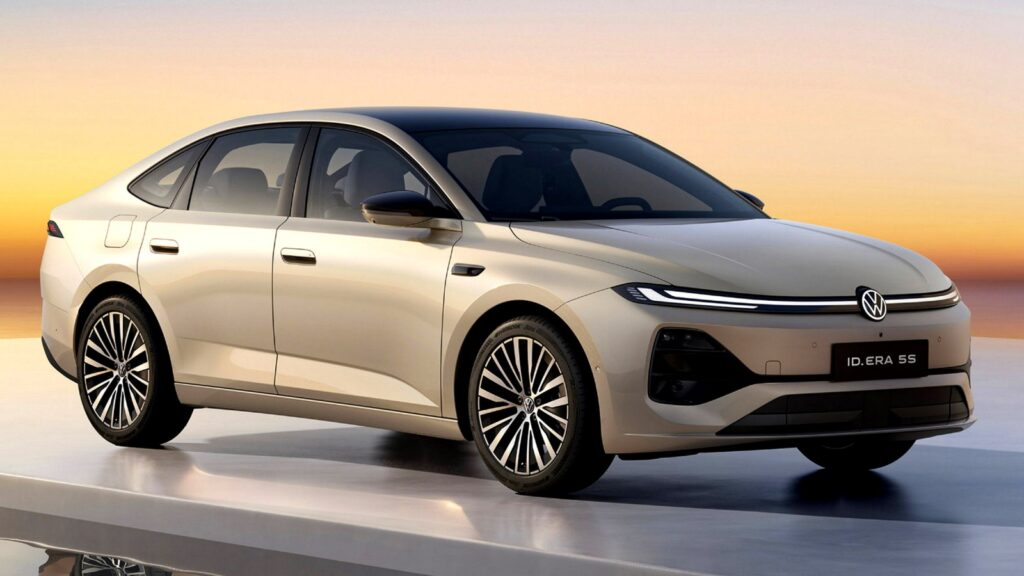
VW’s new sedan is driving itself through Shanghai traffic, weaving through snarled intersections, narrow lanes crowded with bikes and even roads without markings.
Virtually everything that makes the ID. Era 5S significant — its automated-driving system that outperforms what VW offers elsewhere, plug-in hybrid drivetrain and much of the underlying technology — was developed in China, for China.
Priced from just 120,000 yuan (about R317,000), the car illustrates a profound shift at VW.
As the world’s No. 2 carmaker struggles to compete in China, the country is also becoming a source for the cutting-edge technology the company needs to fight back.
Thousands of engineers there are developing vehicles and software faster and more cheaply than their counterparts in Germany, a nation that has long prided itself on its technical prowess.
“China is a key innovation engine for the VW Group and increasingly a product and tech hub for our global markets,” CEO Oliver Blume said in October when the carmaker unveiled its latest technologies developed in the country.
Partnerships with Horizon Robotics and EV manufacturer Xpeng are at the centre of Volkswagen’s push to catch up with local rivals led by BYD, which have set benchmarks for developing affordable cars decked out with the latest gadgetry.
The technologies VW has been building with its Chinese partners could be deployed across the group’s enormous range of vehicles, such as the gasoline-powered Tiguan and ID. Polo electric hatchback.
This would let the carmaker quickly deploy capabilities that have become critical for competing not just in China, but in most of its markets.
Last month, VW laid out its “In China, Beyond China” strategy to export its Chinese models to markets including Mexico, South America and Africa.
The decision raises a bigger question for VW’s $5.8 billion (about R102.05 billion) partnership with Rivian.
In late 2024, the companies set out to develop a new software and electronics architecture for the US and Europe.
But slow progress and the high cost of Rivian’s technology have prompted VW to consider potential alternatives, according to people familiar with the matter.
Some executives, impressed by the speed and quality of the work in China, are pushing to also bring that solution to Europe, said the people, who asked not to be identified because the deliberations are private.
VW is “examining whether certain modules from China can be used in Europe,” the company said in a statement. “No decision has been made on this matter yet.”
The US ban on Chinese connected-vehicle technology effectively walls off much of what VW develops there from the lucrative American market.
Starting with 2027 model-year vehicles, US rules — broadly supported by both major political parties — prohibit Chinese-linked software used for connectivity and automated driving, with restrictions on related hardware taking effect from 2030.
That makes Rivian crucial to VW’s ambitions in the US, providing a local source for vehicle architecture and software it cannot simply bring over from China.
While Europe shares some of Washington’s concerns over potential Chinese access to sensitive data and infrastructure, it’s still allowing in connected-vehicle technology from the country.
VW says it owns the intellectual property of the electronic architecture and software it’s developing in China, and has full control over how the data is handled.
VW’s Chinese push doesn’t mean Rivian’s software won’t make it to Europe. The technology is “fully on track” to be deployed next year in the company’s ID. EVERY1, VW said.
The roughly €20,000 (about R380,000) EV project is seen as a major test of whether the carmaker can profitably compete with Chinese rivals at the affordable end of the market.
The car is “a wonderful way to demonstrate the capabilities of our technology,” Rivian CEO RJ Scaringe said during an earnings call in late October.
It will compete “directly against not only European manufacturers, but also Chinese manufacturers.”
Meanwhile, America’s neighbours Canada and Mexico, as well as some of the industry’s biggest brands, are embracing the technology coming out of China to avoid falling behind.
Mercedes-Benz plans to bring an automated-driving system similar to VW’s to Germany in 2027. The maker of the S-Class said this month it’s shifting to a VW-like ‘China for China’ strategy in an effort to halt cratering sales.
Toyota is building an EV factory in China that will rely on local development and suppliers, a shift from its traditional Japan-focused production model.
The world’s No. 1 carmaker has also tapped Huawei — a company Washington has blacklisted — to bolster its Chinese offering. France’s Renault is expanding its R&D operations in China even as it doesn’t sell cars there.
Volkswagen has been pursuing its local-development strategy since 2022. That gives Europe’s biggest automaker a head start on getting closer to the “China Speed” with which BYD and its peers are upending the global automotive market.
New EV capabilities developed with Xpeng in China are central to VW’s efforts. Unveiled in January after just a year and a half of work, the technology will eventually support all drivetrains and receive software updates every three months.
To speed up development, the carmaker has built an AI toolchain that has cut the time required for function tests from as many as three days to two to three hours.
Software testing that previously took weeks can now be completed in about 20 minutes.
The changes go beyond lines of code. Han Sanchu, a former Huawei executive who oversees VW’s Chinese software R&D efforts, has introduced a new way of working across teams that shortens development cycles to eight weeks, replacing a lengthy, largely sequential path.
“Volkswagen’s German operations and brands have already begun studying and adopting aspects of our China team’s product-development processes,” Han said.
Long-time employees said workdays in China have become longer, a noticeable shift from the more relaxed pace before the company’s sales started slumping.
Appeals for more efficiency are on display throughout VW’s €3.5 billion (around R67 billion) research hub in Hefei, including in restrooms, where one sign reads: “A quick break keeps the line moving.”
The most tangible leap forward is the automated-driving software developed by Carizon, VW’s venture with Horizon Robotics.
Some 800 people are working for the outfit in Beijing and Shanghai, the vast majority of them coders with advanced degrees.
The system they’ve built has completed more than 100,000km of real-world testing — in addition to millions of miles of virtual tests — after VW pulled in staff from its ventures with FAW and SAIC to speed up the process.
During two separate recent drives in Shanghai and Hefei, the software performed smoothly on routes that included multilevel parking garages, narrow roads and sections obstructed by roadworks.
The most sophisticated version, which combines cameras and lidar laser-based sensors, steered the 130,000-yuan (R343,000) ID. Aura T6 sport utility vehicle for 50 minutes without human intervention.
Advanced driver-assistance systems, or ADAS, have become a key factor in purchasing decisions in China, where most local brands offer systems that can pilot cars through dense urban areas.
Blue lights on car exteriors that indicate when they’re in self-driving mode have become something of a status symbol in China.
Drivers are so enthusiastic about ADAS that they’re buying empty Lidar casings to stick on their cars, giving the impression they have the most advanced system installed, such as the one on the Xiaomi SU7 sedan.
“ADAS functions are becoming the standard,” said Li Ziqi, who heads Carizon’s CEO office. “With our technology, we can now compete with the best.”
Initial market feedback is promising. Sales of Volkswagen’s electrified models jumped more than fourfold to a record in October. The ID. Era 5S and ID. Aura T6, featuring new software, drove the increase.
Despite early signs of success with its developed-in-China strategy, Volkswagen still has to prove it can win back sales over a sustained period after some bruising declines.
The German company’s deliveries in China slumped 30% during the first nine months of the year, with fully electric cars accounting for just 3.5% of sales. Its Chinese joint ventures swung to a loss in the period.
But even if VW’s Chinese comeback takes longer to materialise, the technology the company develops in the country is poised to help it compete elsewhere.
That’s signalling a larger shift in the power structure of the global automotive market that may well play out at the expense of Europe.
Protectionist measures designed in Brussels may help keep manufacturing jobs in the region. Yet there’s little chance they’ll prevent some of the industry’s most valuable engineering, software and development work from migrating to China, potentially hollowing out the region’s technical capabilities.
“There’s no question China is becoming the leading hub for EVs and software,” said Matthias Schmidt, an independent auto analyst based near Hamburg. “If you’re a carmaker with access to China, you’d be foolish not to leverage that.”






 Loading ...