South Africa has failed to negotiate a trade deal with the United States before the deadline on Friday, 1 August 2025.
Consequently, the country is now set to be hit by a new 30% tariff on exports within the next seven days.
The US is South Africa’s second largest trade partner, and the new penalty is expected to deal a devastating blow to several local industries in the agricultural and manufacturing sectors.
This extends to South Africa’s auto sphere, as there are seven long-standing original equipment manufacturers (OEMs) with car factories within our borders.
Despite a last-ditch attempt to improve its offer to the US ahead of the cut-off date, the Trump administration confirmed that the tariff will be implemented this month.
US President Donald Trump signed an executive order adjusting the tariffs applied to various countries, including the 30% tariff for South Africa.
Importantly, the executive order states the following:
“These (tariff) modifications shall be effective with respect to goods entered for consumption, or withdrawn from warehouse for consumption, on or after 00h01 eastern daylight time, 7 days after the date of this order.”
This implies that the tariffs will officially kick in at 07h01 on Thursday, 7 August 2025, meaning South Africa may still have a small window of opportunity to bring things back to the negotiating table.
Trump has acknowledged that “some trading partners” have agreed to, or are on the verge of agreeing to, meaningful trade commitments with the United States.
However, he also noted that other trading partners, “despite having engaged in negotiations, have offered terms that, in my judgment, do not sufficiently address imbalances in our trading relationship.”
Various South African government departments, delegations and officials have been trying to develop a trade package over the past few months that would be accepted by the White House to bring the rate down, reported BusinessTech.
However, these efforts were reportedly shot down on multiple occasions, leading to very little progress.
The South African Department of Trade, Industry and Competition (DTIC)’s final offer to the US included the following:
- Importing 750-100 petajoules of Liquified Natural Gas for a 10-year period, unlocking $12 billion
- Agricultural Market Access by simplifying of US poultry exports under the 2016 tariff rate quota and unlock approximately $91 million million in trade.
- Readiness to open market access for blueberries, subject to necessary protocols.
- South African firms are committed to investing $3.3 billion in US industries such as mining and metals recycling;
- Joint investment in critical minerals, pharmaceuticals, and agri-machinery.
- Exemption of specific sectors from reciprocal tariffs to preserve supply chains, e.g. ship building, counter-seasonal agriculture trade, and exports from MSMEs of less than $1 million per annum.
The department said that its efforts to improve the trade deal came down to the wire, with adjustments still being made as late as Thursday, 31 July.
In an interview on 702, DTIC minister Parks Tau said the country had been in communication with the Trump administration until the 11th hour, and that even the US had expressed uncertainty about what would happen next.
“They indicated that they are unable to confirm what the announcement will be, and encouraged us to resubmit an enhanced proposal that will be processed by the White House,” he said.
Unfortunately, the fast-approaching deadline meant it was too late to renegotiate, and the government was forced to adopt a “wait and see” approach, which is a situation that many other countries have adopted in the wake of Trump’s global trade war.
Tau added that the situation has become even more difficult for South Africa because the talks have become political as well as economical.
South Africa’s stance on issues like the Israel/Palestine conflict and its local BEE policies have soured relations with the US, which is now less inclined to offer a better deal.
He mentioned that International Relations Minister Ronald Lamola has travelled to America to address these political issues at the same time that South Africa has been engaged in trade negotiations.
“We have to deal with the reality that, on the trade issues, we are one of many who are dealing with this,” he said.
“We are working all out to address it on all sides. We have pulled out all the stops, engaging with the US through delegations, through business and various channels.”
What this means for carmakers

Tau said that the government has had to account for multiple scenarios and that it still needs to fully assess how different industries will be impacted by the 30% tariff.
In the worst-case scenario, manufacturers will have to pivot their business models to entirely new markets – a move that will be expensive and time-consuming to implement.
In the case of South Africa’s OEMs, the severity of the tariffs varies significantly between carmakers.
VW and Ford, for example, mainly export the Polo hatchback and Ranger bakkie to Europe and are less affected by the new barrier to US trade.
Having said that, the tariffs are expected to have a ripple effect across the entire supply chain, meaning no industry is completely immune.
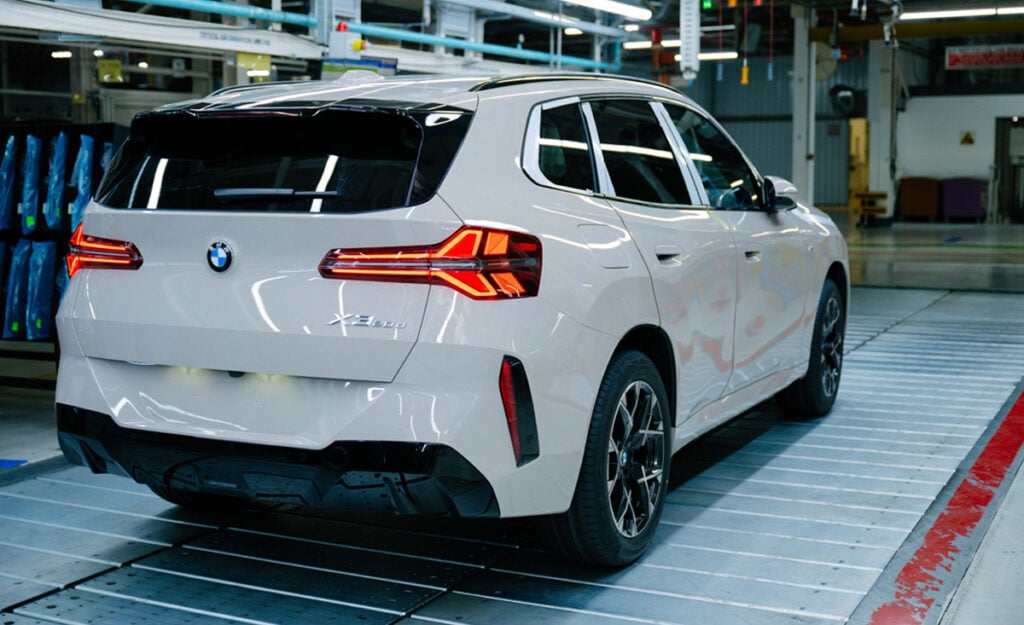
BMW, meanwhile, has found a unique solution to protect its Rosslyn plant, as it plans to export the X3 SUV to Canada rather than the USA.
Canada normally imports the X3 from the States, but the deteriorating relationship between the two countries means it is now looking to import vehicles from other markets, including South Africa.,
Unfortunately, one automaker that is likely to be hit hard by the tariffs is Mercedes-Benz, which produces the C-Class sedan in East London.
The US is a primary market for the C-Class, and other markets like Europe are already supplied by Mercedes’s factory in Germany.
According to Eastern Cape Premier Mlungusi Mvoko, Mercedes is concerned about the future of its South African factory, and is currently searching for new markets it can export to.


 Loading ...
-facelift-2-2025.10.webp)
-2025.11.webp)