


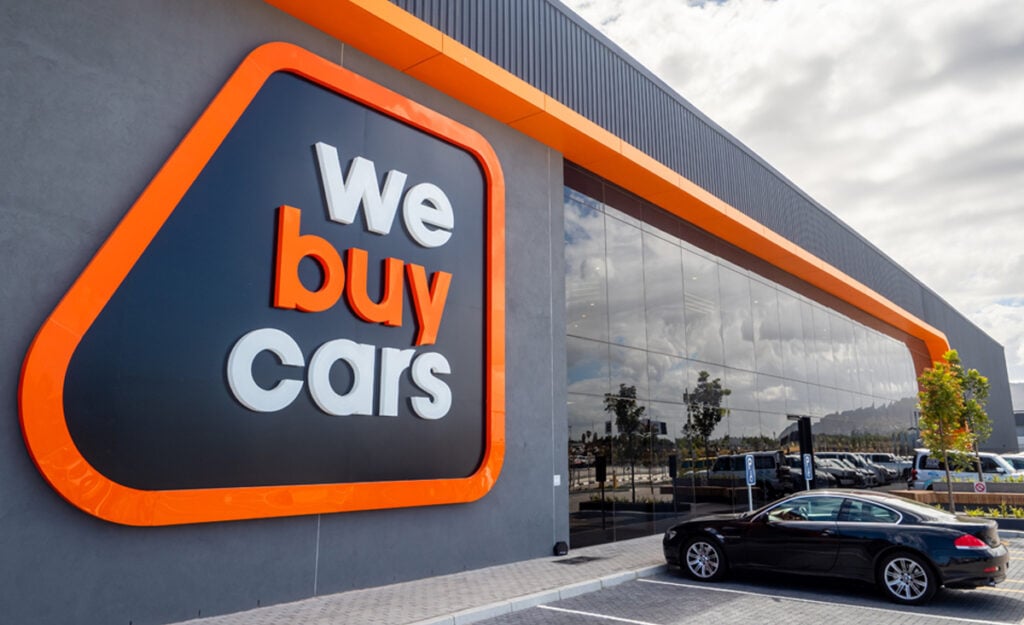
WeBuyCars, one of South Africa’s largest used-vehicle trading platforms, has lost 31% of its value over the last four months on the back of increased competition from cheap Chinese cars and poor results.
Founded in 2001, WeBuyCars was listed on the Johannesburg Stock Exchange (JSE) on 11 April 2024, with an opening share price of R20.00.
It quickly became popular among investors, with its share price rising by nearly 200% in the first 15 months since its listing.
However, this streak of good fortune has faded somewhat, as the company now faces an uphill battle amid new challenges and investor expectations.
This led to a sharp 40% decline in its share price between July 2025 and May 2026, with the last four months particularly bad.
Between 23 January 2026 and 11 May 2026, its shares dropped by 31%, from R52.85 to R36.51.
Consequently, its market cap declined from approximately R22 billion to R15 billion, resulting in a loss of over R7 billion in shareholder value.
There are various contributing factors to this massive loss in value, including increased competition from affordable Chinese cars, shareholder dilution, and shareholder expectations.
Along with this, another thing which affected investors is the sale of R866 million in WeBuyCars shares by Faan and Dirk van der Walt.
This sale was announced on 2 February and forms a part of their personal investment diversification and estate planning.
“The disposal formed part of a considered process of portfolio management, rebalancing and diversification,” said the company.
This led some investors to question the short-term upside potential, which put pressure on the stock downwards.
Analysis

During the last financial year, ending on 30 September 2025, WeBuyCars generated R26.4 billion in revenue and R935 million in profit.
In addition, it supported 12,911 parking bays at its 18 supermarkets across seven of the nine provinces in South Africa and sold 179,006 cars.
This translates to around 490 cars sold daily over the course of the financial year – a figure that is unmatched in South Africa.
However, the company is facing numerous headwinds, the first of which is the South African economy.
Weak GDP growth led to weak consumer confidence, while high living costs limit discretionary spending and reduce the demand for high-value items such as cars.
Adding to this is the arrival of Chinese car brands, which have driven structural shifts in the market through lower pricing.
To maintain liquidity and inventory turns against these competitively priced new vehicles, WeBuyCars had to adjust its selling prices.
This shift in the market placed short-term pressure on the company’s margins to ensure its cars remained attractive to buyers.
Banks also adopted a more cautious approach to consumer credit, leading to tighter approval rates.
This poses a risk to the group as lower approval rates can reduce vehicle sales and the profitable finance and insurance commission income.
To support its aggressive expansion, WeBuyCars invested heavily in onboarding and training staff well in advance of major supermarket openings.
This led to a significant increase in employee costs during the year, with the anticipated benefits of this investment not expected to materialise in the short term.
Rob Pietropaolo, trading co-head at Unum Capital, says WeBuyCars may have become a victim of overhype, and its recent poor performance reflects the impact of cheap Chinese cars.
“A consumer can now get a brand new Chinese car where they would have previously bought a used vehicle,” he said.
He also noted that WeBuyCars is a good and profitable company, but that the initial and rapid rise in its share price was driven more by high expectations than anything else.






 Loading ...
-2026.10.webp)


-2026.10.webp)