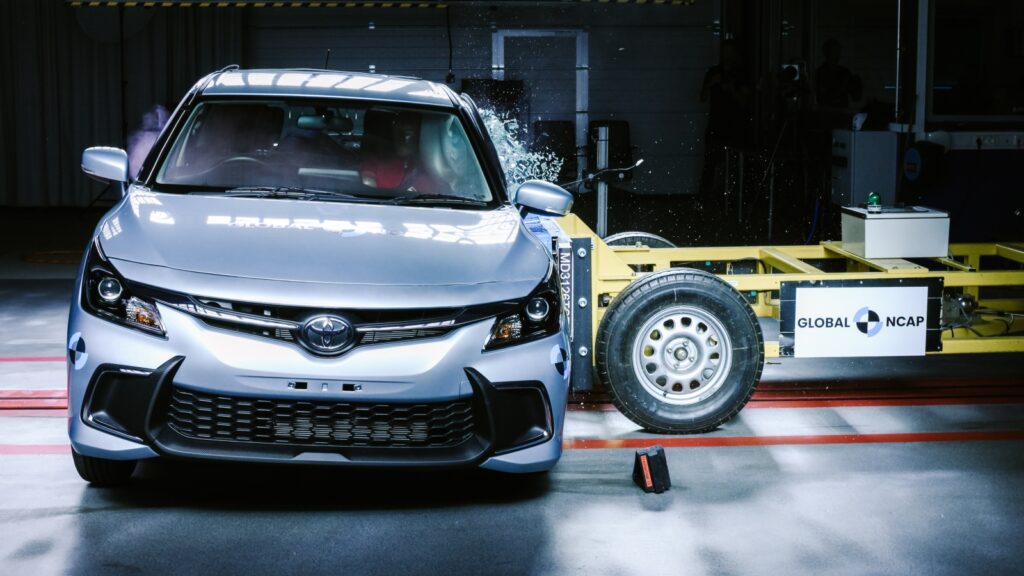
After receiving a zero-star occupant safety rating during crash testing earlier this year, Toyota upgraded the Starlet to six airbags as standard, earning it a four-star rating during the latest tests.
Global NCAP tested the two-airbag hatchback as part of the Automobile Association (AA) of South Africa’s #SaferCarsForAfrica campaign, giving it a zero-star adult occupant safety rating and three stars for child occupant protection.
This version was equipped with driver and front passenger airbags and Electronic Stability Control as standard, but offered no side head protection airbags – which the AA views as essential.
However, Toyota had already upgraded the Starlet to feature six airbags as standard, including side curtain airbags, in a production update at its plant in India.
Following this, Global NCAP offered the Japanese automaker the opportunity to volunteer the six-airbag Starlet for testing, but after the manufacturer refused, it tested the new model with its own funding.
This time around, the six-airbag Starlet achieved four stars for adult occupant protection and the same three-star score for child occupant protection.
Global NCAP’s crash-test assessment found the following:
- The footwell area was rated as stable, while the bodyshell was found to be unstable and not able to withstand further loading in the frontal crash test.
- In the side impact test, head protection was rated as good, and chest protection was adequate. Abdomen and pelvis protection were good.
- In the side pole impact test, head protection was rated as good, and chest protection was marginal. Abdomen and pelvis protection were good.
- In the frontal impact assessment, the head of the three-year-old dummy made contact with the vehicle interior and chest protection was rated as low.
- In the side impact assessment, the head of the three-year-old dummy was exposed to impact.
These results represent significant improvements over the previous results, which the AA noted demonstrated serious failures, particularly during side-impact testing, as it lacks restraint systems like side-body and curtain airbags.
“These findings, in conjunction with a structure that could not provide adequate protection, led to the final Zero Star rating,” reported the AA following the last round of tests.
Toyota’s safety upgrades welcomed
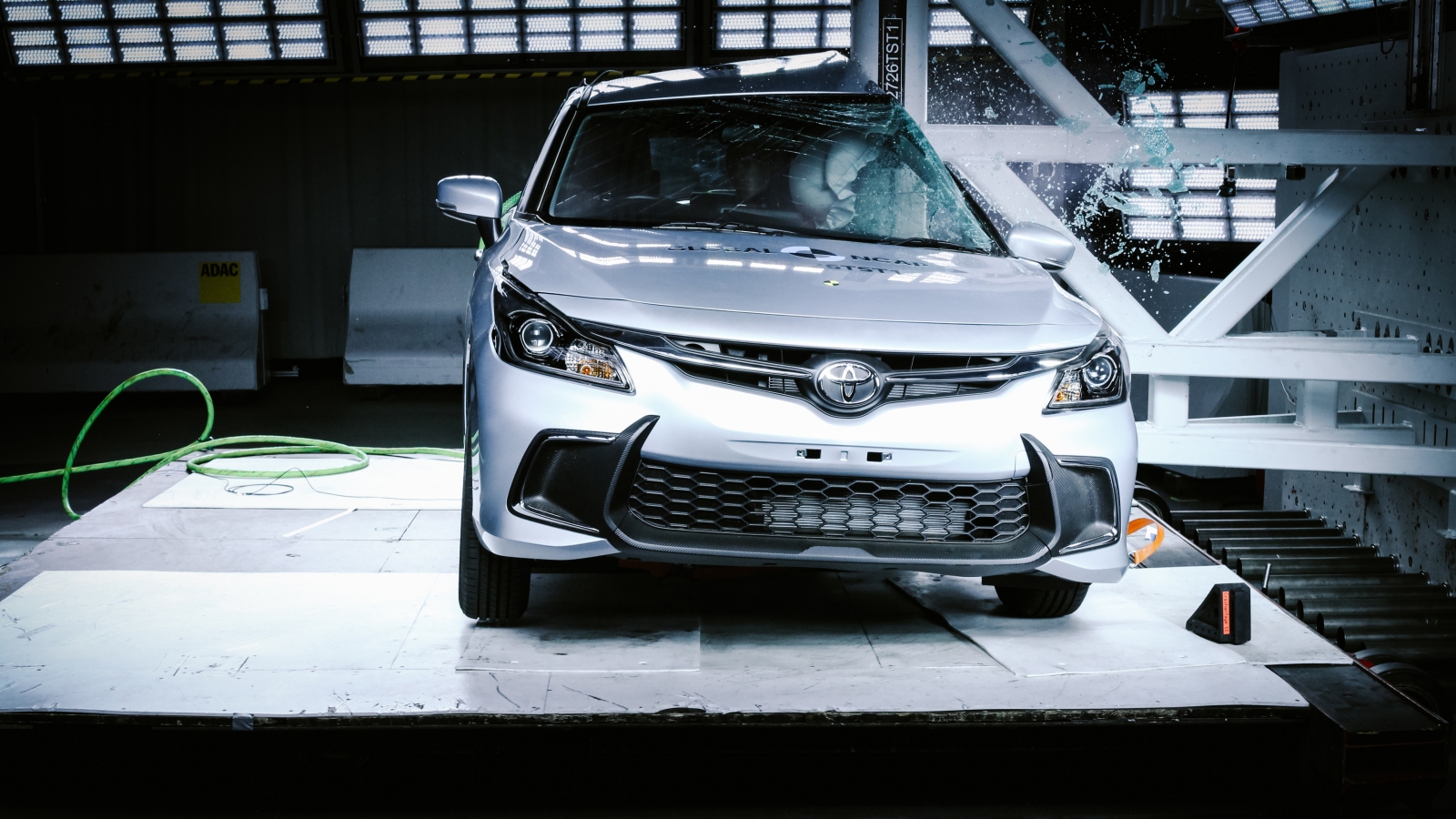
Despite its previous poor performance, the six-airbag Starlet’s performance has seen the hatch go from zero to hero in the eyes of Global NCAP and the local Automobile Association.
Richard Woods, Chief Executive Officer of Global NCAP, said they welcomed Toyota’s decision to upgrade the Starlet in South Africa.
“This four-star result demonstrates what can be achieved when manufacturers make safety a priority,” he said.
“We encourage all manufacturers to adopt similar improvements and to fit life-saving equipment as standard in the markets they serve. Safety should never be reduced to an optional extra.”
Bobby Ramagwede, Chief Executive Officer of the Automobile Association of South Africa, added that the AA welcomes the considerable improvement in the Toyota Starlet’s Global NCAP safety rating.
He added that the company is pleased that the carmaker improved the model’s safety specifications to improve its rating from an unacceptable zero-star rating to a commendable four-star result.
“Improving safety needn’t cost much nor affect the production of entry-level model ranges,” said Ramagwede.
“The result, when manufacturers prioritise the safety of their customers, saves many lives and revives the image of the industry.”
The AA CEO noted that the result serves as an example to other manufacturers of how improvements to safety specifications on entry-level vehicles can instantly yield safer cars on South Africa’s roads.
“We strongly encourage those local brands with recent poorer #SaferCarsForAfrica results to work with us on improving the safety of their affected entry-level models, ensuring that safety is prioritised over cost and proving that African lives matter,” he concluded.


 Loading ...