South Africa played an important role in Artemis II moon mission


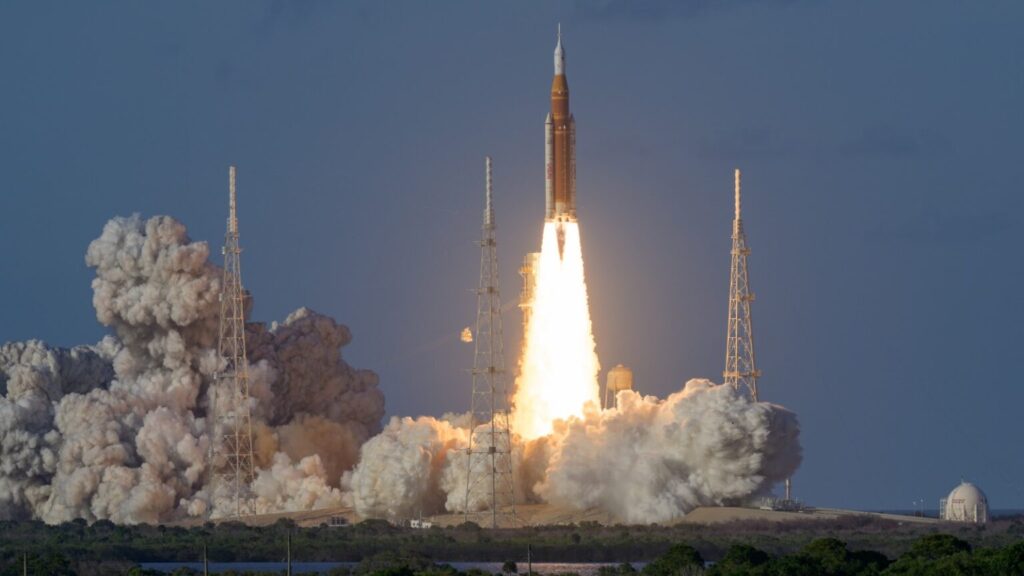
The South African National Space Agency (SANSA) has been a key component of National Aeronautics and Space Administration’s (NASA’s) Artemis II mission to the moon.
The Artemis II mission is scheduled to return to Earth today (10 April 2026) with a splashdown off the coast of Southern California at 8pm EDT.
The journey, which took four astronauts on a 10-day lunar flyby, marks the first time humans have travelled to the moon since the last Apollo mission, Apollo 17, all the way back in 1972.
It represents a collaboration from multiple space agencies around the world, led by NASA, which includes South Africa.
In an interview with Cape Talk, SANSA chief engineer for space operations, Eugene Avenant, revealed that our local space agency played a vital role tracking the spacecraft and supporting the mission.
“SANSA has been tracking the spacecraft, especially in its closer-to-Earth spheres. What is needed for this mission is very accurate orbital information,” he said.
He explained that this includes knowing the spacecraft’s exact trajectory, helping to monitor the astronauts’ safe return.
“Basically, on the outward journey, making sure that the trans-lunar injection burn was correct to ensure that it takes the free-return orbit around the Moon.”
“Now on its homeward journey, [it is] making sure that the burns to correct its orbit for final re-entry are accurate.”
This is done by measuring return signals, or the Doppler Shift, something Avenant described as a one-way doppler.
“That is similar to the noise you hear when an ambulance passes you: the ‘wee-woo’ when it comes past. The frequency changes as the orientation of the spacecraft to Earth changes,” he said.
“Our ground station has been tracking the signal, and apart from relaying telemetry, it has also been making extremely accurate measurements of the frequency of the return signal.”
This data is compiled with information from other ground stations around the world, allowing scientists to track and ensure that the spacecraft is on the correct orbit.
Avenant said that South Africa was involved in the initial planning of the Artemis missions.
This includes the next mission, Artemis III, which will be the first manned lunar landing in more than half a century.
“South Africa was set to use its new ground station under construction in Matjiesfontein to also provide critical services to that mission,” he said.
“However, two weeks ago, NASA Administrator Bill Nelson announced a reshuffling of the Artemis programme, so now Artemis IV will be the first mission to make a lunar landing.”
Headline image credit: NASA




 Loading ...