
The legal device that airport security can confiscate in South Africa


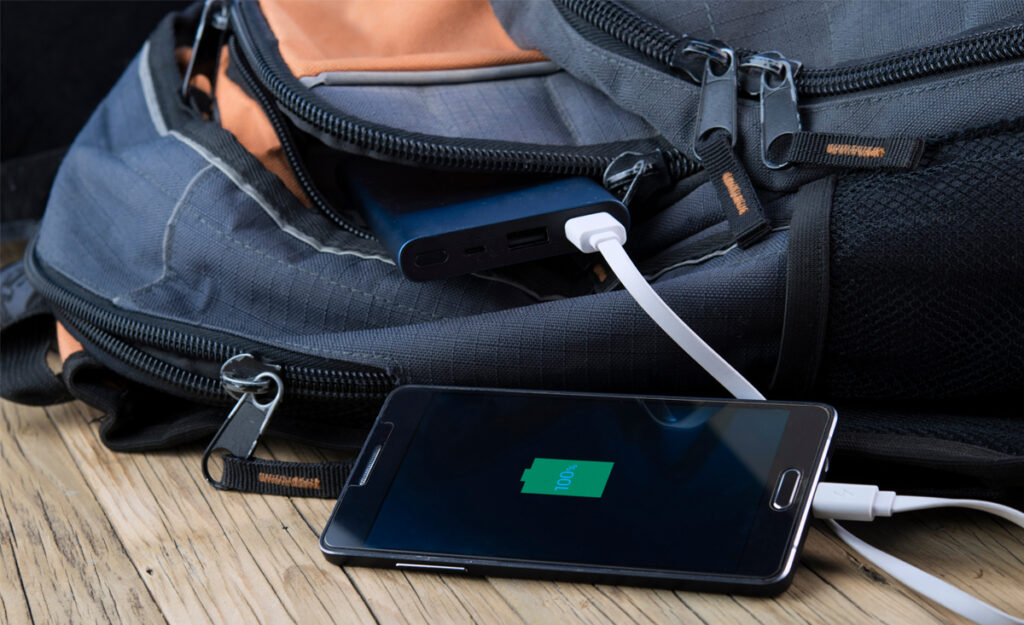
Airport authorities in South Africa and other countries can confiscate power banks if the devices do not adhere to strict regulations.
Power banks are subject to airline rules governing the use of electronic devices passengers are allowed to take aboard aircraft.
These devices must be under a certain wattage and are only allowed in carry-on luggage, as they pose a fire hazard and must be supervised.
South Africa’s largest domestic air carrier, FlySafair, restricts power banks from being stored as checked-in luggage, in adherence with international safety rules.
“Power banks are spare lithium‑ion batteries, which means they fall under international battery safety rules and must always travel in your carry‑on baggage,” it said.
“This is a global aviation safety standard and one of the most common rules passengers are caught out by at check‑in.”
Power banks and other devices with lithium-ion batteries are not allowed in check luggage, and airports will scan checked bags for power banks using X-ray machines.
FlySafair noted that it does not allow power banks over 160Wh on passenger aircraft, regardless of whether they are stored as carry-on luggage.
Power banks with a watt-hour rating of between 100Wh and 160Wh are permitted on aircraft without airline approval. This applies to most phones, tablets, laptops, and standard power banks.
In accordance with international laws, most power banks have the watt-hour rating marked on the device.
This usually takes the form of text at the bottom of back of the device that reads something like “45Wh.”
An issue that travelers may run into is that some devices don’t list the watt-hour rating and only show the milliamp-hours (mAh).
If this is the case, you will need to do a conversion to work out the watt-hour.
To do this, you need to multiply the mAh by the voltage (V) and divide by 1,000. The internal voltage of most power banks is 3.7V, according to MyBroadband.
For example, a 20,000 mAh power bank is 20,000 × 3.7 / 1,000 = 74 Wh.
While FlySafair says it follows international safety standards, other countries are far stricter when it comes to enforcing these rules.
Personal experience
Last year, I travelled to China to attend the Shanghai Auto Show. I flew from Johannesburg to Shenzhen, and from Shenzhen to Shanghai with a group of other South African journalists.
On the way there, I encountered no issues with my 20,000 mAh Samsung power bank, which I kept in my carry-on backpack to charge my phone when needed.
However, on the return journey, our group had to pass through security at Shanghai Pudong International Airport.
We all took our laptops and other electronic devices to put through the X-ray machine while we passed through the metal detectors. The airport security staff also asked whether we carried lighters.
The staff inspected my Samsung power bank, turning it over to check the printed mAh and Wh ratings. Mine was handed back to me without issue.
However, two of the individuals in our group had power banks from unfamiliar brands. Both devices were confiscated, even though they had a lower capacity than mine at 10,000 mAh.
I hadn’t seen their power banks beforehand, though I assume that these devices didn’t clearly display their mAh and Wh ratings.
This was in April 2025, and China has since imposed a blanket ban on all power banks on flights to and from the country that do not carry a specific Chinese safety certificate mark.
China’s Civil Aviation Administration said that power banks must be clearly marked with “3C” certification before they can be allowed on flights.
This year I wasn’t so lucky, as I visited China again to attend the 2026 Beijing Auto Show.
Like before, I travelled from Joburg to Beijing via Shenzhen. While in Shenzhen I had to pass through security to make my connecting flight.
The staff there examined my power bank for several minutes before handing it back to me with an indifferent shrug.
A week later, I flew from Nanjing to Shenzhen, where it seemed my luck had finally run out, as my Samsung power bank was confiscated.
The security officer was quite apologetic about it, explaining that China had introduced new regulations and that my device was no longer permitted.
In the end, it means I’ll have to buy a new power bank here in South Africa, and I’ll be looking for one with the latest safety certifications to ensure I don’t encounter a similar issue when travelling internationally in the future.



 Loading ...