


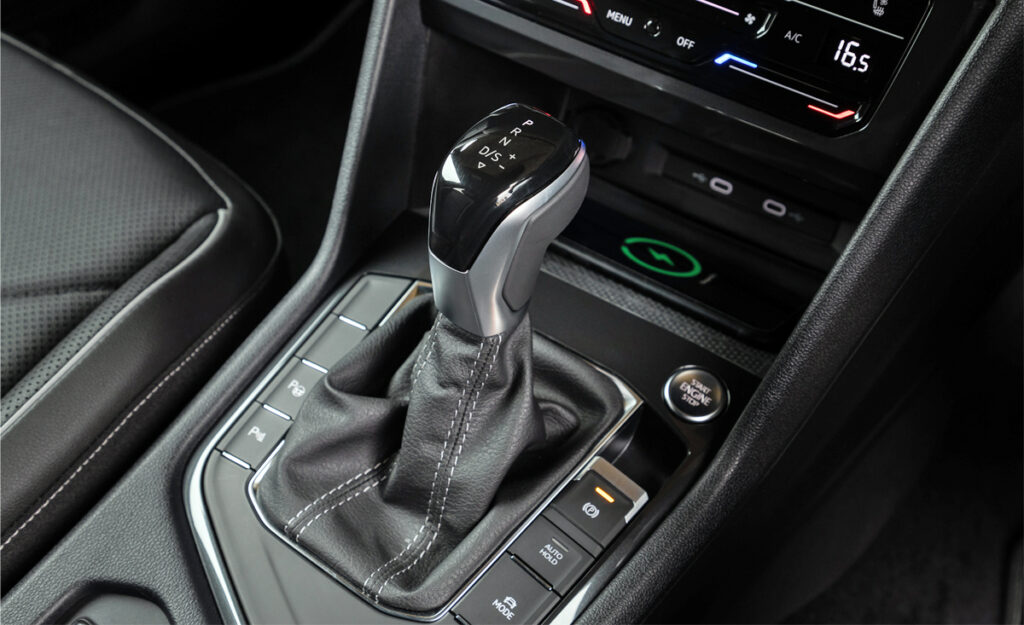
When it comes to comparing transmissions, most motorists are familiar with the differences between a manual and an automatic gearbox, but fewer understand the difference between an automatic and a CVT.
While manual transmissions require constant input from the driver to choose the right gear at the right speed, automatic transmissions do this automatically based on the vehicle’s speed and the engine’s revolutions.
A CVT, or continuously variable transmission, operates similarly to an automatic gearbox, with several key differences.
When driving an automatic vehicle, all the driver needs to do is select from a set of gear options – Park, Reverse, Neutral, or Drive – leaving the transmission to do all the work for them.
Once the accelerator pedal is pressed down, the transmission matches the engine and road speeds for the driver, selecting gear ratios in a manner that maximises efficiency and performance delivery.
While a CVT operates similarly, its construction is completely different, not using any gears at all.
Instead, these rely on two cone-shaped pulleys that transfer power from the engine, through the transmission, to drive the wheels.
These pulleys continually vary their width depending on power inputs, hence the name, and working in tandem, these pulleys allow a CVT to accelerate more smoothly.
The average driver won’t notice the differences between a CVT and a traditional automatic transmission while driving.
Modern automatic transmissions are so advanced that drivers already find it tough to tell when a gear change has occurred, meaning they will have to pay close attention in order to feel a gear shift.
When driving a CVT-equipped vehicle, there are no gear changes when accelerating, so while drivers may hear the engine revolutions increase as they speed up, there is no “shift shock” involved.
The pros and cons of a CVT

There are several reasons a buyer may opt for a vehicle fitted with a CVT transmission, which all boil down to saving money.
Unlike traditional automatics, a CVT changes gear ratios continuously to maintain the engine running at peak efficiency, leading to better fuel efficiency.
Furthermore, CVT transmissions tend to be lighter and smaller than a conventional automatic transmission, occupying less space than their traditional equivalent.
Another benefit of having a CVT-fitted car is that it is much less complicated, much faster to assemble and less costly to manufacture.
Beyond the cost savings, these transmissions are also popular for their smoothness, as they adapt to road conditions without ‘hunting for gears.
As a result, regardless of the circumstances, driving remains smooth and constant because the transmission does not actually shift gears.
Unfortunately, CVTs are not yet made for high-performance, but instead focus on efficiency, increasing their appeal in hybrid vehicles.
Another reason drivers would prefer to avoid CVTs is their feel, as throttle action feels slightly more delayed than other transmissions.
In certain situations, a CVT-equipped vehicle can maintain higher revolutions without undue engine wear and tear, though this higher RPM may feel ‘wrong’ for someone not used to driving a car with a CVT.
The biggest drawback to this type of transmission is its increased maintenance frequency, which includes changing transmission fluid every 100,000km compared to every 120,000km in a traditional automatic.
CVTs are relatively new in the automotive sector, meaning the number of certified professionals who work on these is smaller than that of those who work on ‘standard’ automatic transmissions.
As a result of the absence of accredited CVT technicians, independent workshops may charge a higher price to service these ‘new’ gearboxes.





 Loading ...
-2026.10.webp)

-2026.10.webp)