


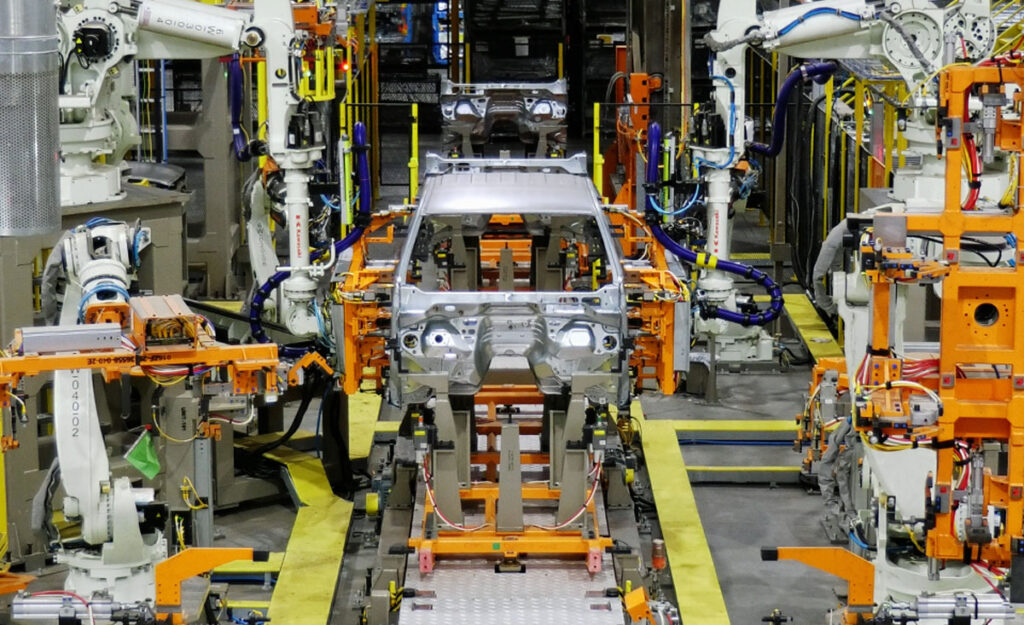
Department of Trade, Industry and Competition (DTIC) Minister Parks Tau has published draft changes to the Automotive Production and Development Program (APDP) to support local electric vehicle (EV) battery manufacturing.
The changes aim to increase the number of materials that will qualify for government incentives, and help local car manufacturers build electric car parts and EVs.
The CEO and Executive Director of the National Association of Automotive Component and Allied Manufacturers (Naacam), Renai Moothilal, told 702 this is a step in the right direction.
“It’s definitely a positive move and building on what was outlined a couple of years ago in the EV White Paper published by the DTIC,” he said.
“What we are seeing is an implementation of a policy that had already been worked out.”
Moothilal explained that the minister’s draft changes seek to tackle some of the challenges facing the local automotive industry.
“It is effectively looking to incentivise one of the highest value components in the type of vehicles that we are starting to see consumed in mass globally.”
He added that the changes still have to go through the technical comment period, but believes it is something to be welcomed.
Touching on the EV White Paper, Moothilal explained that it would have been better to see the government move more quickly to implement certain policies.
“To some extent, some of the changes globally have meant that not necessarily things that we spoke about two or three years ago still remain,” he added.
“I do think there’s a lot of space to grow the domestic NEV (new energy vehicle) ecosystem, and I think as policy makers that’s where some of the emphasis needs to go.”
Policies and incentives are already in place

Moothilal noted that while there is still work to be done to implement policy reform regarding local EV production, there are steps that have been taken.
“From a production perspective, we have seen at least three key implementation levers, with the most recent one what we are speaking about today,” he explained.
“But two years ago, we did see an additional cash incentive for NEV components, and last year, as we saw in the budget presented by the Finance Minister, there’s 150% accelerated depreciation allowance for electric vehicles produced in South Africa.”
Moothilal said that while there has been movement, demand conditions in the local market need to be addressed.
Until demand improves and South Africa produces NEVs locally, the country will remain reliant primarily on Chinese manufacturers.
“China is a formidable competitor, and they’ve built the NEV ecosystem through probably close to two decades of very targeted industrial policy,” explained Moothilal.
“Probably more than 60% of any EVs sold globally are produced in China, and it’s the same with the key components, including battery production.”
He welcomed South Africa’s attempt to end this reliance on Chinese EV imports, especially during the country’s current period of fiscal constraints.
“I do think the kind of measures that are being looked at, for example, the customs rebates and the tax-based incentives, are the right way to go,” said Moothilal.
“What we are seeing is an attempt to use our own domestic levers to help them consider South Africa and the region as investment destinations, technology partners.”
He mentioned that the country holds a distinct mineral advantage, which gives credence to bringing large Chinese component producers to our shores.
This includes the new entrants expected to launch in the local market, which Moothilal mentioned are already considering ways of localising high-value components.
“This is a step in the right direction. We could always have a lot more, but it’s good to see some of this coming across the line,” he concluded.



 Loading ...
-2026.10.webp)

-2026.10.webp)