


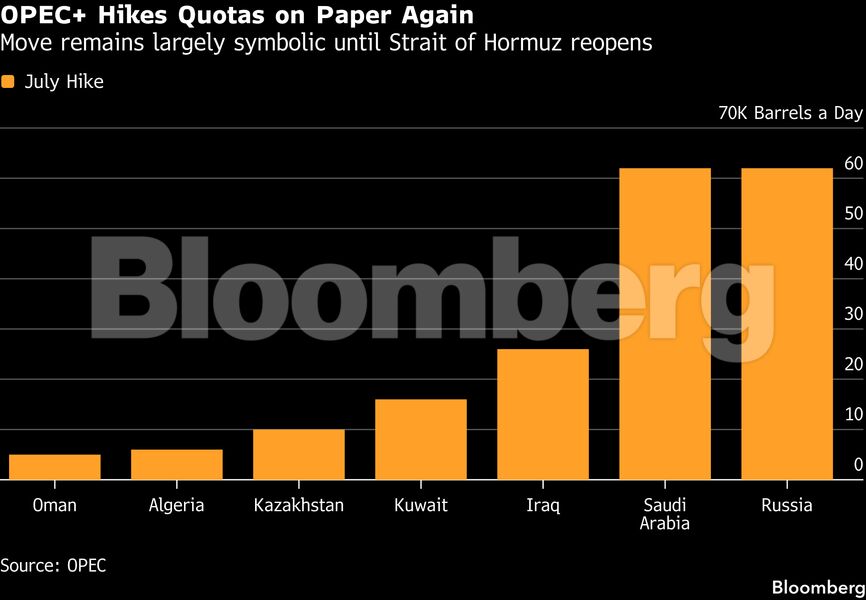
Major OPEC+ members agreed on another modest symbolic increase to their oil output quotas for July, even as a blockage of exports from the Persian Gulf prevents most of them from implementing it.
Seven nations led by Saudi Arabia and Russia will raise their collective target by 188,000 barrels per day next month, continuing the process — if only on paper — of restarting production halted several years ago, the Organisation of the Petroleum Exporting Countries said in a statement on Sunday after a video conference.
With the Strait of Hormuz largely closed by the Iran war and Middle East producers forced to cut output, the OPEC+ decision remains theoretical for the time being.
It could become relevant again when the waterway reopens, with buyers clamouring for barrels to replenish the world’s depleted oil inventories.
“At this stage, we are basically talking about hypothetical future scenarios with the bulk of the barrels stranded,” said Helima Croft, head of commodity-markets strategy at RBC Capital Markets.
While Russian shipments aren’t directly affected by the war, its crude production has also been challenged, falling to a 10-month low in May as Ukraine intensified strikes on its oil infrastructure.
A surge in US supply and diminished Chinese buying have prevented crude oil prices from spiralling out of control so far, though fuels such as gasoline, diesel and jet fuel have nevertheless surged during the conflict.
That’s squeezing consumers worldwide and heightening the risk of an economic downturn. Still, markets haven’t rallied as much as feared while China dials back imports, major consumers tap emergency stockpiles, and US President Donald Trump repeatedly signals an imminent peace deal.
The seven OPEC+ nations engaged in monthly quota adjustments will next meet on July 5. Besides the Saudis and Russia, they consist of Iraq, Kuwait, Kazakhstan, Algeria and Oman.
The UAE announced its departure from the organisation effective 1 May, ending six decades of membership. Abu Dhabi had long been frustrated that OPEC’s quotas prevented it from deploying new investments in production capacity.
For most of the past year, key OPEC+ nations had been restoring output halted several years ago, when the alliance was trying to stave off a surplus and shore up prices.
They’ve continued the process since the war started, even though the conflict prevents many of them from raising production.
With the quota increase for July, the group will have nominally restored almost 90% of the two layers of production halted in 2023.
Last month, delegates said the group had a plan to complete that chunk with increases from July to September.
Those supplies amounted to 3.85 million barrels per day at the time, though the volume has been reduced slightly as a result of the UAE’s exit.
A third layer, which equated to 2 million barrels a day when it was taken offline in 2022, is due to remain shut down until the end of the year.
Delegates said last week it could be fast-tracked, but even then, most of the oil wouldn’t materialise.
Pledged supply increases over the past year have fallen significantly short of the advertised amounts as a combination of under-investment, ageing oil fields and sanctions has eroded production capacity in many OPEC+ members.





 Loading ...
-2026.10.webp)



-2026.10.webp)