
South Africa’s longest tunnel connecting two historic towns


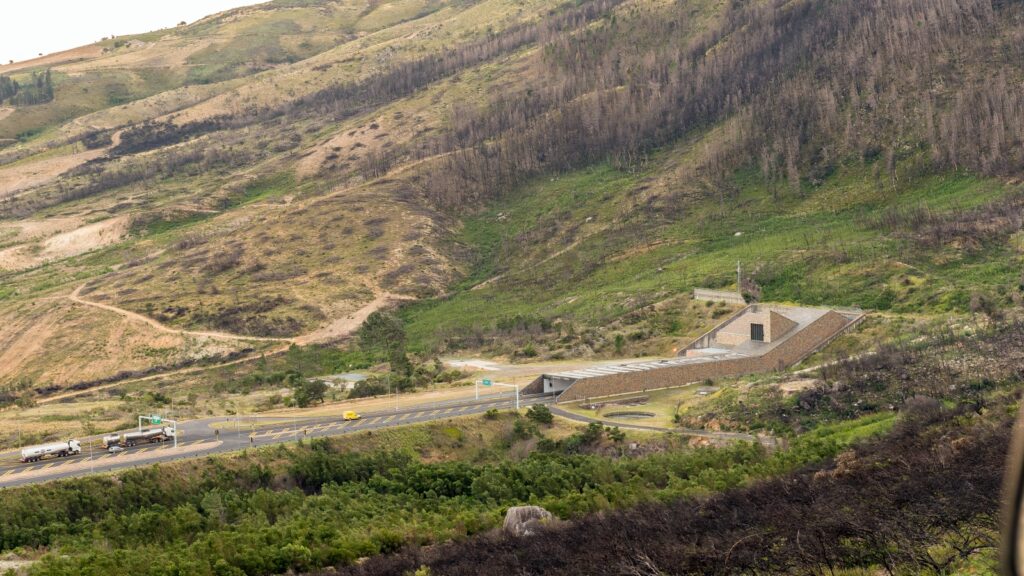
The Huguenot Tunnel near Cape Town forms part of the N1 national road and extends through the Du Toitskloof mountains, connecting Paarl at its western portal with Worcester at its eastern portal.
Spanning 3.9km, it is not only South Africa’s longest road tunnel, but also the longest road tunnel in Africa, and allows motorists to bypass the steep, winding Du Toitskloof Pass over the mountain.
This shortens the route by 11km and reduces travel time by 15 to 26 minutes while avoiding hazardous weather conditions like heavy mountain fog and rockfalls.
Proposals for a tunnel through the mountain range date back to the 1930s, but the Second World War delayed development, and the pass was built between 1942 and 1948 instead.
Geological surveys began in 1973, before full-scale drilling and blasting began in 1984, and engineers bored through solid granite rock simultaneously from both the eastern and western portals.
When the two tunnelling crews met in the middle, the alignment error across the nearly 4km distance was only 3 millimetres.
Four years later, the tunnel’s construction, which cost R202.6 million, was completed and named after the French Huguenot refugees who settled in the neighbouring Winelands in the late 17th century.
According to the South African National Roads Agency (SANRAL) 2024 Milestones report, the tunnel has accommodated more than 100 million vehicles since it opened on 18 March 1988.
On an average day, 13,000 cars pass through the Huguenot Tunnel, with this number spiking to between 25,000 and 40,000 during peak holiday travel periods.
Traffic currently operates in a single, bi-directional tube, with one lane in each direction, and a speed limit of 90km/h, though this could soon change.
When the tunnel was built in the 1980s, a second parallel tube, the North Bore, was excavated to act as a pilot tunnel and emergency escape route.
SANRAL has long-term plans to fully equip the North Bore with road surfaces, ventilation, lighting, and safety portals.
Once fully commissioned, each tube will carry one-way traffic with two lanes, doubling the overall corridor capacity and increasing safety.
R4 billion upgrade to utilise the North Bore

In 2024, SANRAL initiated plans and tenders for the North Bore Tunnel to expand the network from two to four lanes, which it anticipates will cost around R4 billion.
While the South Bore accommodates travel in both directions, SANRAL’s goal is to separate traffic with a two-lane, one-way system for the south and north routes.
The project will also include upgrades to the South Bore Tunnel, whose electrical and mechanical systems have neared the end of their life and need replacement to ensure compliance with international safety standards.
Construction was expected to start in the first half of 2025. However, this did not materialise, and the project is still in the procurement phase.
When the tender process opened in 2024, former SANRAL CEO Reginald Demana stated that the project would bring the Huguenot Tunnel in line with international standards.
Updated and upgraded features and safety measures will include:
- Sensors for monitoring air quality, traffic conditions, and lighting conditions
- An intelligent, distributed jet fan ventilation system for optimal fresh air supply
- Wind turbines installed next to the tunnel entrances to reduce energy demand
- An additional high-level reservoir to provide water in the event of fire emergencies
- Transparent wind barriers on the River Viaduct to minimise the risk of trucks overturning
According to SANRAL’s planning, construction is expected to take five years, if the project does not run into unforeseen challenges.
The roads agency will start by opening the North Bore Tunnel to allow for traffic to flow when it closes the South Bore for refurbishing.
Stellenbosch University physics researchers have also proposed constructing the Paarl Africa Underground Laboratory (PAUL) inside the rock surrounding the tunnel during the North Bore civil works.
If realised alongside SANRAL’s construction, it will become Africa’s first deep-underground physics research laboratory.

 Loading ...
-2026.10.webp)



Conversation
4 commentsSA is slowly moving to the right direction, like it or not! Pity, it doesn’t sounds good to the minority 😀.