


The city of Gqeberha (formerly Port Elizabeth) in the Eastern Cape is home to three different car factories, making it one of South Africa’s largest automotive production centres.
The coastal city has played a major role in shaping the country’s car industry and continues to do so to this day with facilities that produce cars and engines for three automakers: Isuzu, Ford, and BAIC.
Ford’s history in Gqeberha dates back all the way to the early 20th century, when the American Ford Motor Company began to sell the famous Model T in South Africa.
The automaker appointed Arkell & Douglas in Port Elizabeth (PE) as its first sales agents in South Africa. When its vehicles proved to be a major hit, Ford decided to begin local assembly operations.
In 1923, the Ford Motor Company of South Africa was formed in PE. The city was chosen due to its strategic access to the country’s road, rail, and port network.
Ford established its first factory in a repurposed wool store, which became the Ford Company’s 16th vehicle assembly plant outside of the United States.
Over the decades, Ford expanded its operations, moving to a larger facility and later establishing the dedicated Struandale engine factory to supply its main assembly plant in 1964.
Today, Ford’s centre of business has moved to Silverton in Gauteng, where it produces the popular Ranger bakkie for the local market and for export overseas.
However, the Struandale plant still exists in PE today. In 2023, the site celebrated the production of its 4 millionth engine, a 2.0-litre bi-turbo diesel block, which was sent to the Silverton factory to be installed in a Ranger.
Other car brands with a presence in Gqeberha

Ford is not the only carmaker with a presence in the Eastern Cape, as Isuzu has its own plant in Gqeberha.
In 1971, General Motors purchased a 34% share in Isuzu Motors and started importing Isuzu models to South Africa via its General Motors South Africa subsidiary.
Two years later, the Isuzu KB bakkie was introduced in our market, though it was originally badged as the Chevrolet LUV.
The pickup was later produced at GM’s factory in PE. In 1978, it was rebranded as the Isuzu KB. Fast forward to 2006, and Isuzu Truck was officially established in South Africa as a joint venture between Isuzu and GM.
The two carmakers continued to operate together in our market until 2017, when the American giant announced it was withdrawing from South Africa.
Isuzu agreed to acquire GM’s remaining 30% share in Isuzu Truck, and took over all of GM’s other assets, including its factory in PE.
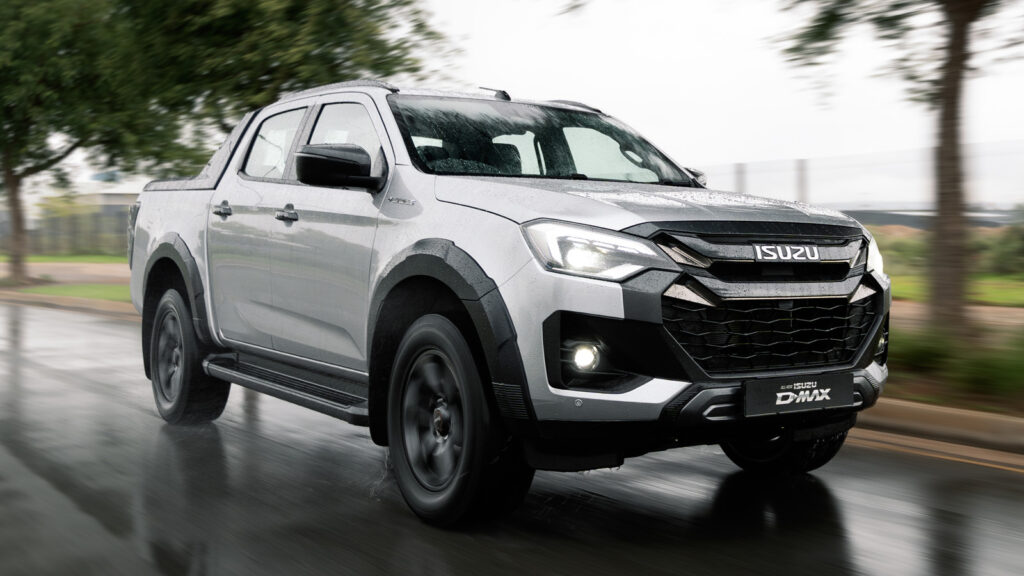
As of 2026, the company operates as Isuzu Motors South Africa and produces the D-Max bakkie and larger commercial vehicles at its factory in the Eastern Cape.
The last company to establish a presence in Gqeberha is a relatively new entry, as the Chinese carmaker BAIC opened a plant in 2018.
Two years prior, the BAIC Group had signed a joint development agreement with the Industrial Development Corporation (IDC) to build a factory in South Africa.
Work on the site, located in the Coega Special Economic Zone, began in 2016, and the first model, a BAIC X25 made from a semi-knocked-down kit, rolled off the production queue in 2018.
The factory got off to a very slow start, which BAIC attributed to the Covid-19 pandemic, contractor disputes, and the Russia-Ukraine war, which disrupted its production schedule.
In mid-2023, the company announced that it had begun production of the Beijing X55 crossover and B40 Plus SUV. However, media who visited the site reported that the factory was very quiet and only had a skeleton crew.
BAIC said this was due to low demand for the crossover on the local market, and that the site would get busier as sales picked up.
In late 2025, BAIC announced that it would also build the B30 4×4 SUV at the factory, claiming that intense competition in its home market had prompted the company to turn to Africa for further expansion.
These cars are built from complete-knock-down kits, in contrast to the semi-knock-down kits used for the earlier models.
Furthermore, BAIC has expanded the plant to include its sub-brand Foton, which now produces the Tunland G7 bakkie.
In March 2026, Foton announced that it had begun assembling the Tunland series from complete-knock-down kits.
“The launch of CKD production at our Gqeberha facility represents a major milestone for Foton globally and for South Africa’s automotive industry,” Marius Smal, CEO of Foton South Africa, said at the time.
“By establishing its first overseas manufacturing base in South Africa, Foton is expressing confidence in the country’s industrial capability, skilled workforce, and strategic importance as a gateway to regional and international markets.”



 Loading ...
-facelift-2-2025.10.webp)

Conversation
1 commentsUnfortunately CKD does not bring much to the country.