New Isuzu D-Max launched in South Africa – Pricing and features


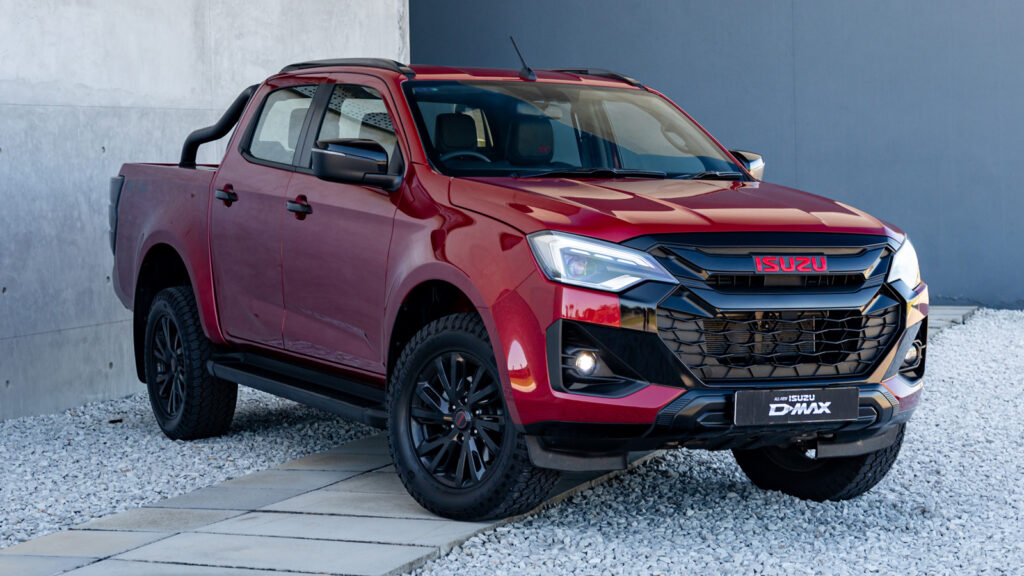
Isuzu has officially launched the updated D-Max series in South Africa.
The D-Max is one of the country’s most popular bakkies, selling thousands of units every month while competing with the Toyota Hilux and Ford Ranger.
The current-generation models, which are produced at Isuzu Motors South Africa’s factory in Struandale, Gqeberha, were first introduced back in 2022.
Now, Isuzu has updated the series for the 2026 Model Year, adding six new derivatives and improving the engine selection.
“We are building on the D-Max’s proven reputation for exceptional efficiency, durability and reliability with a comprehensive range of mid-cycle upgrades that enhance the all-round capability, style, comfort and safety offered to our customers,” said Kevin Fouché, Department Executive, Product Planning, at Isuzu.
The new bakkie series is available in single, extended, and double cab configurations with prices starting at R433,860, R533,690, and R574,010, respectively.
Engines
While the D-Max will continue to be sold with either a 1.9-litre or 3.0-litre turbocharged engine, the former has been updated to provide better performance.
“One of the main changes is the adoption of the latest-generation 1.9 Ddi engine, which has been further developed for improved throttle response and low-down torque, matched to enhanced efficiency, reduced emissions and better cold-start performance,” said the company.
It has an upgraded turbocharger with an electronically controlled actuator for faster response compared to the previous vacuum actuator.
It also benefits from a new high-pressure fuel pump and high-pressure common rail injection system, which receives the fuel rail pressure sensor found on the 3.0 Ddi engine – all of which enhances combustion efficiency.
The engine’s output is unchanged at 110kW and 350Nm; however, Isuzu said that it now develops an additional 130Nm at 1,600rpm compared to the old version.
The 3.0-litre turbo-diesel units are unchanged and continue to produce 140kW and 450Nm.
One major improvement across the range is that all 4×4 units now benefit from hill-descent control and a Rough Terrain Mode that increases the effectiveness of the traction control when travelling off-road.
“Activated by a button on the gearshift console, Rough Terrain Mode limits the torque to any spinning wheels through stronger application of the brakes on that wheel, in combination with more aggressive throttle control,” said the Japanese automaker.
“This effectively directs driving power to the individual wheels with more traction. It can also distribute more power from the front to the rear axle if required, thereby assisting the vehicle in gaining traction and proceeding safely.”
Rough Terrain Mode’s engine and brake control is available in two-wheel drive (2H), four-wheel drive high-range (4H) and low-range (4L).
It also enables the use of traction control when the differential lock is engaged.
Other aspects of the pickup are the same as before, meaning it can be had with either a six-speed manual or automatic gearbox, and fuel consumption ranges from 7.0l/100km to 8.1l/100km, depending on the model.
Appearance

Along with the engine improvements, the D-Max has received a facelift with unique details for different models.
The higher-end variants now have a “Miura-ori” digital texture pattern for a more striking appearance.
New LED daytime running lights (DRLs) with integrated turn indicators, located above the LED headlamps, are now standard from the LS trim level onwards, replacing the previous underslung DRLs.
The bakkie’s front fascia has been modernised with new triangular fog light bezels and an air curtain that funnels air from the bumper to exit out the wheel well.
This, along with a new front skid plate and bumper side skirts, helps to reduce drag and noise, thereby improving efficiency and comfort.
At the back, the LS units and up have been given new three-step LED taillight clusters. The tailgate has also been redesigned with a larger upper spoiler for better aerodynamics.
Features

The D-Max Single Cab is now available in seven variants in Base and L trim levels.
“The range starts with the new 1.9 Ddi Low Ride Base model – a value-oriented offering that is ideally suited to workhorse commercial applications where efficiency, low running costs and reliability are the priority,” said Isuzu.
“The High Ride Base model continues in the line-up, with the benefit of increased ground clearance.”
All D-Max units come standard with ABS, Electronic Stability Control with Traction Control, Hill Start Assist, Electronic Brake Force Distribution, Brake Override Accelerator, and a minimum of dual front airbags.
The Base and L also feature a new 4.2-inch TFT instrument cluster, and an 8-inch infotainment screen with wireless Apple CarPlay and Android Auto.
One step up is the LS, which has new 17-inch alloy rims, rain-sensing wipers, automatic headlights, lumbar support for the front seats, and front and rear USB Type-C ports.
Next is the X-Rider, which was previously limited to the 1.9-litre engine, but which can now be had with the 3.0-litre.
This version stands out with a black exterior with red decals, a redesigned sports bar, and exclusive X-Rider badges.
Inside, there are red accents on the dash and gearshift, black leather seats with red stitching and an X badge embroidered on the headrests, and a 7-inch driver display with X decorations.
Moving on, we have the LSE, which has 12-spoke 18-inch alloy wheels, Silky Silver and Dark Grey exterior finishes, and new ‘Hexa Pod’ and ‘Miura-ori’ pattern digital textures for the cabin.
“Semi-gloss silver finishes on the new U-shaped dashboard garnish provide a high-class contrast to the piano black treatment for the air vents and centre console surround,” said the company.
It has a new 9-inch touchscreen with two dials and five touch switches, heated seats, and paddle shifters on the steering wheel for the automatic versions.
The range-topping V-Cross has new black chrome and dark grey metallic exterior finishes, and six-spoke 18-inch alloys.
Added features include adaptive cruise control, and traffic sign recognition with a Gen4 stereo camera that can detect speed, no overtaking, no entry, yield, and stop signs.
The camera has increased the vehicle’s field of view from 40 to 120 degrees, helping to improve the lane-keep assist, traffic jam assist, and rear cross-traffic brake function.
The V-Cross also has forward collision warning, autonomous emergency braking, turn assist, lane departure warning, emergency lane keeping, and blind spot detection.
Finally, there’s the halo-model AT35, which features extensive off-road modifications courtesy of the famous Arctic Trucks brand.
It is larger than any of the other D-Max models with flared wheel arch extensions housing 17-inch alloys with 35-inch all-terrain BF Goodrich tyres.
It also has a specially-developed lift kit that raises the ride height, ground clearance, water-wading depth, approach and departure angles, and break-over angle.
Other fittings include AT35 side steps and mud flaps, a ResQ puncture repair kit, an 18-inch spare wheel, and exclusive Arctic Trucks branding for the gearshift, headrests, and floor mats.
Pricing
The South African pricing for the new Isuzu D-Max series is as follows:
Single Cabs:
- Isuzu D-Max 1.9TD Single Cab Low-Rider – R433,860
- Isuzu D-Max 1.9TD Single Cab – R463,860
- Isuzu D-Max 1.9TD Single Cab L manual – R483,650
- Isuzu D-Max 1.9TD Single Cab L auto – R502,230
- Isuzu D-Max 1.9TD Single Cab L 4×4 manual – R585,200
- Isuzu D-Max 1.9TD Single Cab L 4×4 auto – R603,600
- Isuzu D-Max 3.0TD Single Cab L 4×4 auto – R689,090
Extended Cabs
- Isuzu D-Max 1.9TD Extended Cab L manual – R533,690
- Isuzu D-Max 1.9TD Extended Cab L auto – R553,690
- Isuzu D-Max 1.9TD Extended Cab LS manual – R561,190
- Isuzu D-Max 1.9TD Extended Cab L 4×4 manual – R583,690
- Isuzu D-Max 1.9TD Extended Cab LS auto – R584,340
- Isuzu D-Max 1.9TD Extended Cab LS 4×4 auto – R634,340
- Isuzu D-Max 3.0TD Extended Cab LSE – R700,760
- Isuzu D-Max 3.0TD Extended Cab LSE 4×4 – R785,720
Double Cabs
- Isuzu D-Max 1.9TD Double Cab L manual – R574,010
- Isuzu D-Max 1.9TD Double Cab L auto – R593,880
- Isuzu D-Max 1.9TD Double Cab LS manual – R611,730
- Isuzu D-Max 1.9TD Double Cab LS auto – R633,290
- Isuzu D-Max 1.9TD Double Cab LS X-Rider manual – R668,990
- Isuzu D-Max 1.9TD Double Cab L 4×4 manual – R670,800
- Isuzu D-Max 1.9TD Double Cab LS X-Rider auto – R690,810
- Isuzu D-Max 1.9TD Double Cab LS 4×4 auto – R717,700
- Isuzu D-Max 1.9TD Double Cab LS X-Rider 4×4 auto – R776,890
- Isuzu D-Max 3.0TD Double Cab LS 4×4 manual – R791,200
- Isuzu D-Max 3.0TD Double Cab LS X-Rider – R792,470
- Isuzu D-Max 3.0TD Double Cab LS 4×4 auto – R810,960
- Isuzu D-Max 3.0TD Double Cab LS X-Rider 4×4 – R844,470
- Isuzu D-Max 3.0TD Double Cab LSE – R850,880
- Isuzu D-Max 3.0TD Double Cab V-Cross – R898,380
- Isuzu D-Max 3.0TD Double Cab LSE 4×4 – R900,310
- Isuzu D-Max 3.0TD Double Cab V-Cross 4×4 – R948,930
- Isuzu D-Max 3.0TD Double Cab AT35 4×4 – R1,211,910
Each purchase comes with a 5-year/120,000km warranty with roadside assistance, and a 5-year/90,000km service plan.
2026 Isuzu D-Max



 Loading ...