South Africa’s motor vehicles, parts and accessories and other transport equipment sector slipped 11.0% year-on-year and decreased by 2.7% in April compared with March this year.
This is according to recently released Statistics South Africa (Stats SA) data, which highlights this as one of the primary drivers of the overall manufacturing downturn of nearly 1% for the month.
Stats SA’s data is backed by that of the Automotive Business Council (Naamsa), which noted that vehicle exports throughout the month declined by 4.0% year-on-year.
“Exports remained under pressure in April 2026, with vehicle export sales reaching 30,939 units, down 1,290 units, compared to the 32,229 units exported in the corresponding month last year,” Naamsa said.
It attributed this poorer performance to geopolitical developments and their impact on key destination markets.
“The April decline was largely driven by the LCV segment, which contracted sharply by 42.9% due to the phased rollout of new-model production by a key exporter,” the council noted.
The motor vehicles, parts and accessories and other transport equipment sector carries a weight of 7.84% in the overall manufacturing index for the 2022–2026 period, making it a significant contributor.
Year-on-year production of bodies and panels for motor vehicles, trailers, and semi-trailers grew by 10.8% in April, while other transport equipment manufacturing also grew by 8.0% during the same period.
Conversely, motor vehicle manufacturing declined by 2.7%, while parts and accessories production, the biggest contributor to the decline, plummeted by 22.1%.
Naamsa noted that April 2026 marked a clear inflexion point in the macroeconomic environment.
“The escalation of geopolitical tensions in the Middle East triggered a sharp repricing in global energy markets, with oil prices moving structurally higher and introducing a broad-based cost shock across energy-intensive sectors,” it reported.
A 35% reduction in bakkie exports

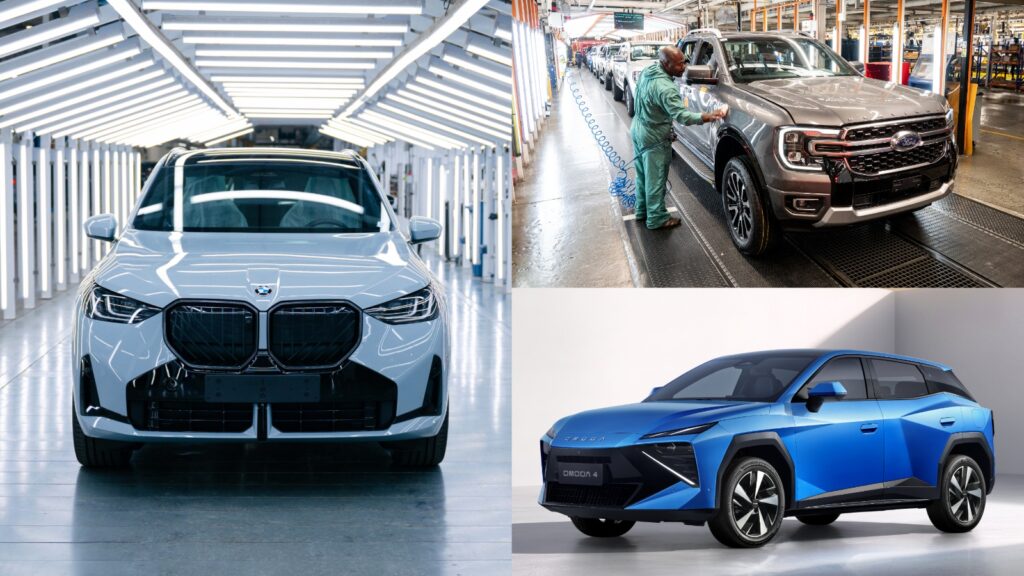
South Africa’s bakkie-building factories have experienced the most difficulties, with sales fluctuating since the start of the year, and exports falling off significantly.
Bakkies continue to be a favourite among local buyers, as they offer practicality and the necessary toughness required to survive South African road and driving conditions.
For this reason, locally-built bakkies, including the country’s favourite bakkie, the Toyota Hilux, as well as the Ford Ranger and Isuzu D-Max, are also popular in export markets.
Despite their popularity, 2026 has been a tough year for bakkie exports, even though local sales have remained strong.
Data compiled from Naamsa’s monthly reports indicate that March was the best month for both the local and export bakkie market.
More than 15,000 light commercial vehicles (LCVs) were sold in South Africa in March 2026, while nearly 12,000 locally-built bakkies were shipped in the same month.
This came after the year started with only 10,996 local sales and 7,094 exports in January, followed by a much stronger 13,218 local purchases in February, accompanied by 4,500 exports.
At the time, Naamsa lauded the increase, noting that the increased demand for LCVs aligned with conditions in the goods-producing sectors.
It said these were gradually stabilising as energy supply improved and logistics reforms gained traction.
Global tensions and macroeconomic factors, including higher fuel prices and financial uncertainty, put an end to the improved outlook.
By April, local bakkie sales had faltered to 10,966, down 4,591 units from the high of 15,557 sold a month earlier.
Last month, local bakkie sales remained resilient, thanks to a reported 10.5% year-to-date (YTD) increase, while export figures remained worlds apart.
May’s overall export figures represent a staggering 49.5% year-on-year (YoY) decline compared to May 2025, including a staggering 34.7% YTD decrease in bakkie exports by the close of May 2026.




 Loading ...